MasterFabric Logo
v1.7
AI-Portfolio

MasterFabric · Lakehouse Lab

A complete lakehouse you can run on one laptop, fed by a synthetic mobile operator.

sha 6ba927f·snapshot 2026-11-23·View on GitHub →
MasterFabric Lakehouse Lab: Spark, Apache Iceberg, Trino and S3 object storage on one laptop, with measured results

Overview

MasterFabric Lakehouse Lab is a complete lakehouse stack that runs entirely on a single laptop, fed by a synthetic mobile operator's raw switch CDRs, packet-core sessions, a CRM extract and cell inventory. Data is landed, cleaned and turned into business marts through a medallion bronze, silver and gold pipeline on Apache Iceberg tables written by Apache Spark, queried interactively by Trino, and stored in S3-compatible object storage. The lab deliberately builds in the problems real platforms hit, such as duplicate and late-arriving records, timestamp format changes, correction feeds and the small-file problem, and then shows with measured numbers how a 20-rule quality gate, write-audit-publish on Iceberg branches, Great Expectations auditing and OpenLineage-based lineage into Marquez deal with each one.

Key measured results

  • 01Scale benchmark ran from 0.26 M to 2.1 M raw rows (scales 1 to 8); total pipeline time grew from 32.43 s to 68.59 s, so 8x the data costs 2.1x the time.
  • 02Throughput through bronze to gold rises from about 11k to 62k rows/s as scale increases.
  • 03168 of 19,377 cell-hours (0.87%) are congested at the 0.8 utilization threshold; the Scala ranking job turns that into a backlog of 8 P1 cells, 5 P2 cells and 107 to monitor, in 3.26 s.
  • 04The transparent baseline churn score reaches ROC AUC 0.647 and a 1.90x top-decile lift against the generator's held-out labels.
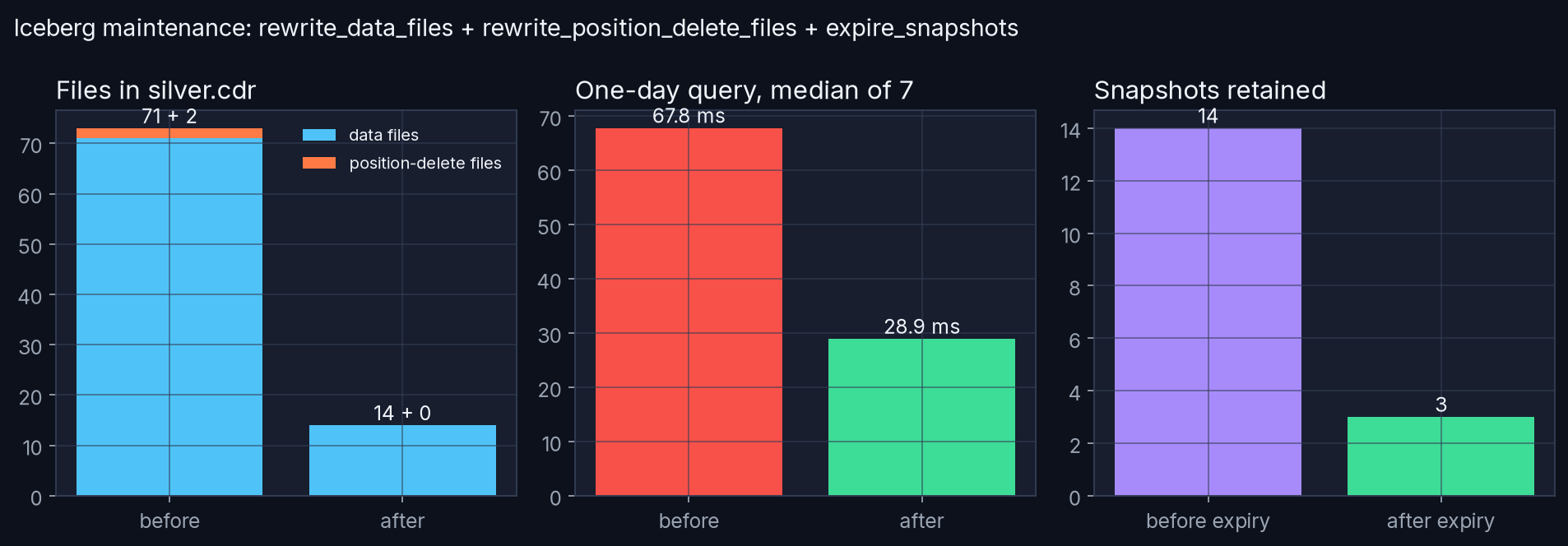
  • 05Table maintenance reduced data plus position-delete files from 71 + 2 to 14 + 0, cut a one-day query from 67.8 ms to 28.9 ms, and reduced snapshots from 14 to 3, with compaction taking 1.24 s.
  • 06Scheduled maintenance under a stream: after 60 batches of 2,000 rows each, the unmaintained table holds 74 data + 10 position-delete files, 81 manifests and 71 snapshots and answers the one-day query in 156.5 ms, while the table maintained every 20 batches holds 5 + 0 files, 2 manifests and 5 snapshots and answers in 28.1 ms, with the same result (120,000 rows, 145,731.40 TRY) at every checkpoint.
  • 07The unmaintained table slows linearly, from 37 ms at the start to 156.5 ms after 60 batches (about 2 ms per batch); the maintained table is a sawtooth that climbs to about 67 to 70 ms between passes and drops back to 28 to 33 ms after each one, with a maintenance pass taking 1.38 to 1.75 s.
  • 08A catch-up pass on the unmaintained table compacted 70 data files into 1 in 1.45 s and brought the query to 26.8 ms, but the object count rose from 307 to 329 because retain_last => 5 keeps snapshots that still reference the pre-compaction files.
  • 09Orphan cleanup after a simulated crashed writer: 188 objects listed, 183 referenced; the production 1 hour age guard kept all 5 orphans, while a 0 s guard deleted the same 5 files (2.11 MB), a second scan found 0 orphans, and the query result was unchanged.
  • 10Write-audit-publish: a release 2.3 delivery of 14,684 rows passed 11/11 Great Expectations checks and was published via fast_forward in 0.061 s; a buggy release 2.4 delivery passed only 8/11 and was blocked.
  • 11Rollback via rollback_to_snapshot restored main from 123,689 rows back to 138,373 rows in 0.057 s, a metadata-only commit.
  • 12Lineage export from one pipeline run plus the write-audit-publish job recorded 54 jobs and 16 datasets in Marquez, collapsed to 23 dataset edges, with column lineage for 10 datasets.
  • 13The quality gate's 20 rules all passed (20/20) on every benchmark run; the test suite includes 8 unit tests plus 12 Spark/Iceberg tests.

Honest limitations

  • Laptop scale only: the largest run is 2.1 M raw rows, showing fixed-cost behaviour rather than cluster throughput, not a claim about production performance.
  • MinIO was replaced by RustFS because the MinIO images could not be pulled anonymously on the day of the build; nothing in the code depends on RustFS.
  • No Hadoop s3:// connector in the Spark image, so raw files are read from a bind mount and the orphan scan uses Iceberg FileIO instead of the built-in action.
  • Catalog and engines are unauthenticated and bound to localhost, with no Kerberos, TLS, Ranger or credential vending; the REST catalog is a reference fixture, not a production server.
  • Data is synthetic: behaviour patterns such as hourly profile, churn propensity and under-dimensioned cells are modelled rather than learned from real traffic, and the panel weight (60) is an explicit assumption.
  • The Iceberg demo runs once per lake, changing the schema and partition spec of silver.cdr; replay requires resetting and rerunning the pipeline and demos.
  • Write-audit-publish is shown on one table only; gold is not rebuilt from the published day, branch retention is not automated, and the learned thresholds come from seven days of synthetic data.
  • The lineage run purges and regenerates the lake so its result files go to a separate output folder, meaning the committed pipeline results are from an earlier benchmark run; Marquez runs under emulation on Apple silicon.
  • Lineage gaps: column lineage stops at bronze.cdr_raw for the CDR feed, branch writes are recorded as writes to silver.cdr, and Marquez has no authentication in this setup.
  • The maintenance experiment is one run on small tables of a few MB: query times are medians of 7 on a laptop, so the ratios matter, not the milliseconds; the orphan cleanup is a FileIO scan rather than Iceberg's remove_orphan_files, and the crash is simulated by copying files, not by killing a writer.
  • Spark runs in local mode with one JVM and four cores, with no shuffle service, executors or dynamic allocation to tune.

Screenshots & diagrams

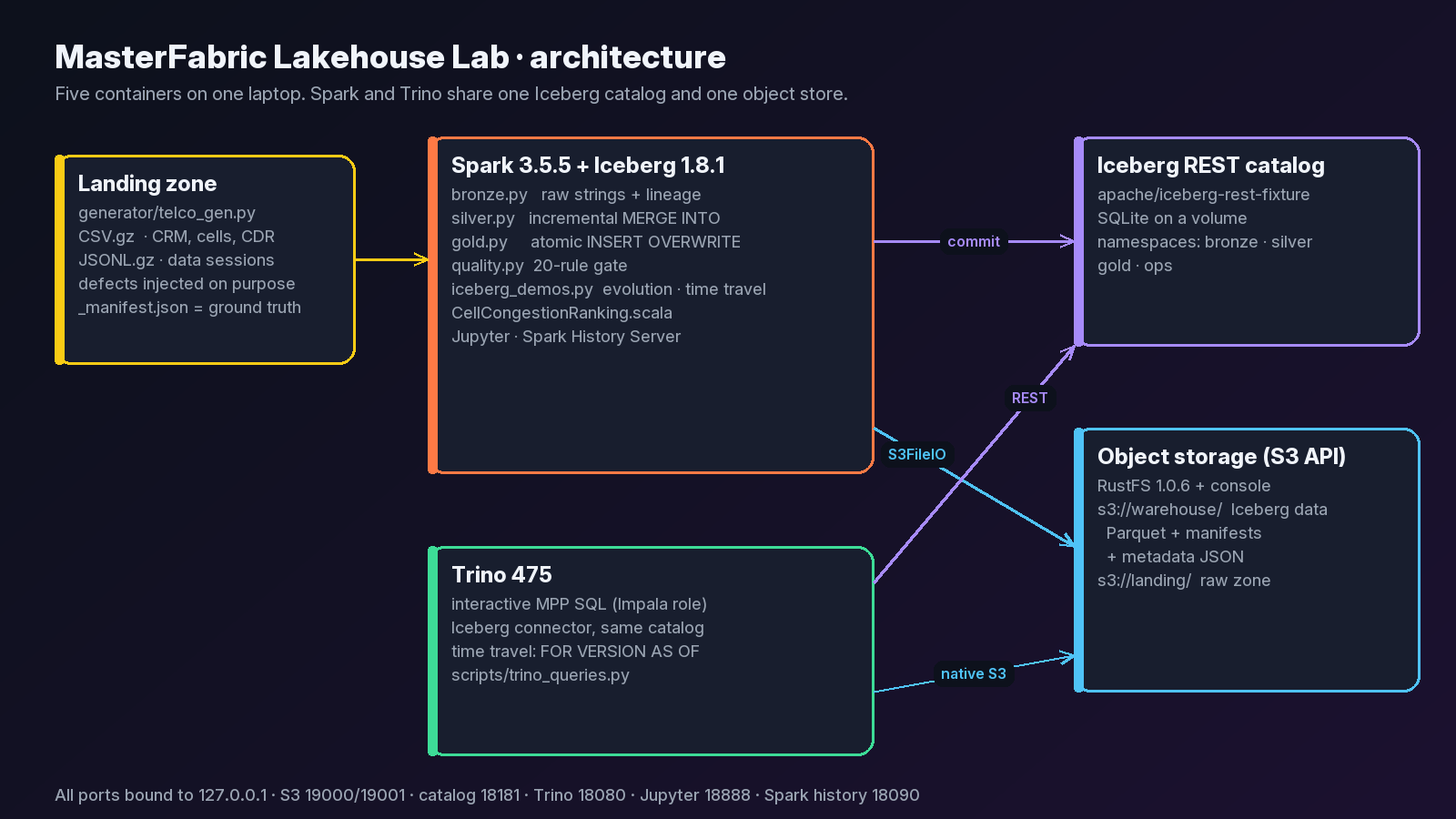
Five containers: landing zone, Spark with Iceberg, Iceberg REST catalog, S3 object storage, Trino
Medallion flow with real counts: landing, bronze, silver, gold and the quality gate
Heatmap of mean utilization by hour of day for the 14 most congested cells
ROC curve of the baseline churn score, AUC 0.647
Data files and position deletes grow with every MERGE micro-batch
Files, query time and snapshots before and after maintenance
Files, manifests, query time and metadata bytes over 60 batches for the maintained and unmaintained table
Objects listed and referenced, and orphans kept, deleted and remaining
Branch, audit, publish and rollback flow with measured row counts and times
Pass and fail grid for the 11 expectations on both deliveries
Great Expectations Data Docs page for the failed validation
Dataset lineage from landing folders through bronze and silver to gold, coloured by job
Marquez UI showing the lineage graph of gold.daily_subscriber_usage
Stacked per-layer wall time for scales 1, 2, 4 and 8
RustFS console with the warehouse and landing buckets
Parquet data files of one daily partition of silver.cdr
Spark SQL plan of the silver MERGE
Spark History Server SQL tab of the silver job
Trino cluster overview with finished queries
Trino query detail
Trino query detail
Notebook: time travel
Spark History Server application list
Lab components mapped to Cloudera CDP components