MasterFabric Logo
v1.7

MasterFabric

AI-Portfolio

Nine repositories · one organization · measured, not marketed

These nine public repositories are a hands-on, measured, on-prem and local-first data and AI architecture portfolio. Each one runs on ordinary developer hardware, reports what was actually measured rather than estimated, and states its limitations plainly rather than presenting a finished platform.

Figures below are read from a local snapshot of each repository’s main branch (latest snapshot: 2026-11-23). They can be refreshed whenever the source repositories change — see each repository’s page for its exact commit SHA and date.

Labs in motion

Simulations from measured results

Every animation here is a simulation. Every figure shown as a result comes from the measured snapshots of each repository and is quoted from them; nothing is invented or extrapolated.

Canary, rollback and drift-triggered retrain

Simulation of the measured gates. Bars grow from zero to the measured values; nothing between them was measured.

Canary stages

5%25%50%

v6 rolled back at 5% (Spearman -0.088). v5 passed all stages, paired delta AUC -0.0007 [-0.0031, +0.0016], and was promoted.

Rollback, seconds to serve

  • v4 → v3
    3.41 s
  • back to v4
    15.27 s

Drift watcher

  • PSI
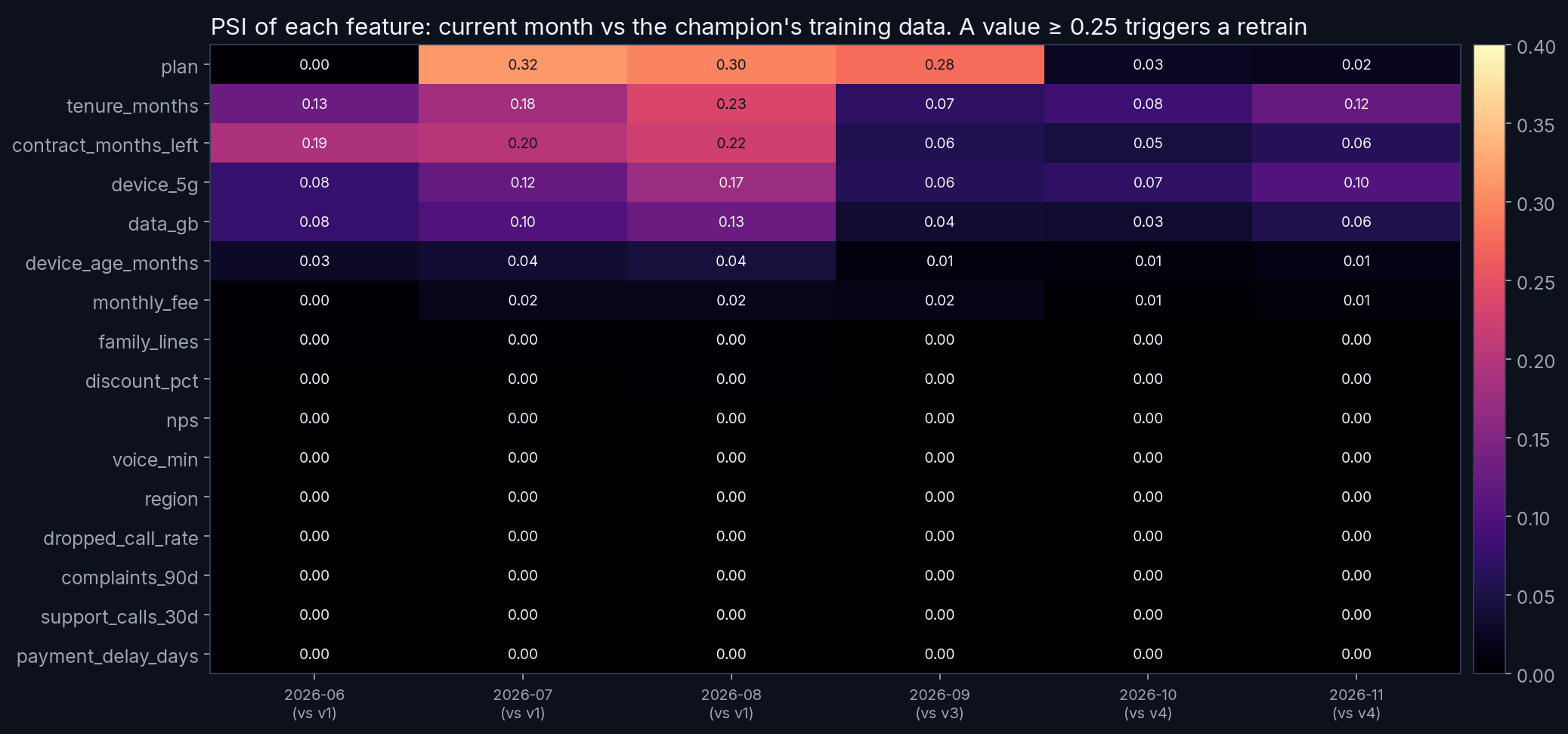
    0.266
  • Trigger
    0.25

v10 rejected (0.7816 vs v1 0.7819); v11 promoted (0.819 vs 0.7796), served 4.1 s later.

Measured · content/data

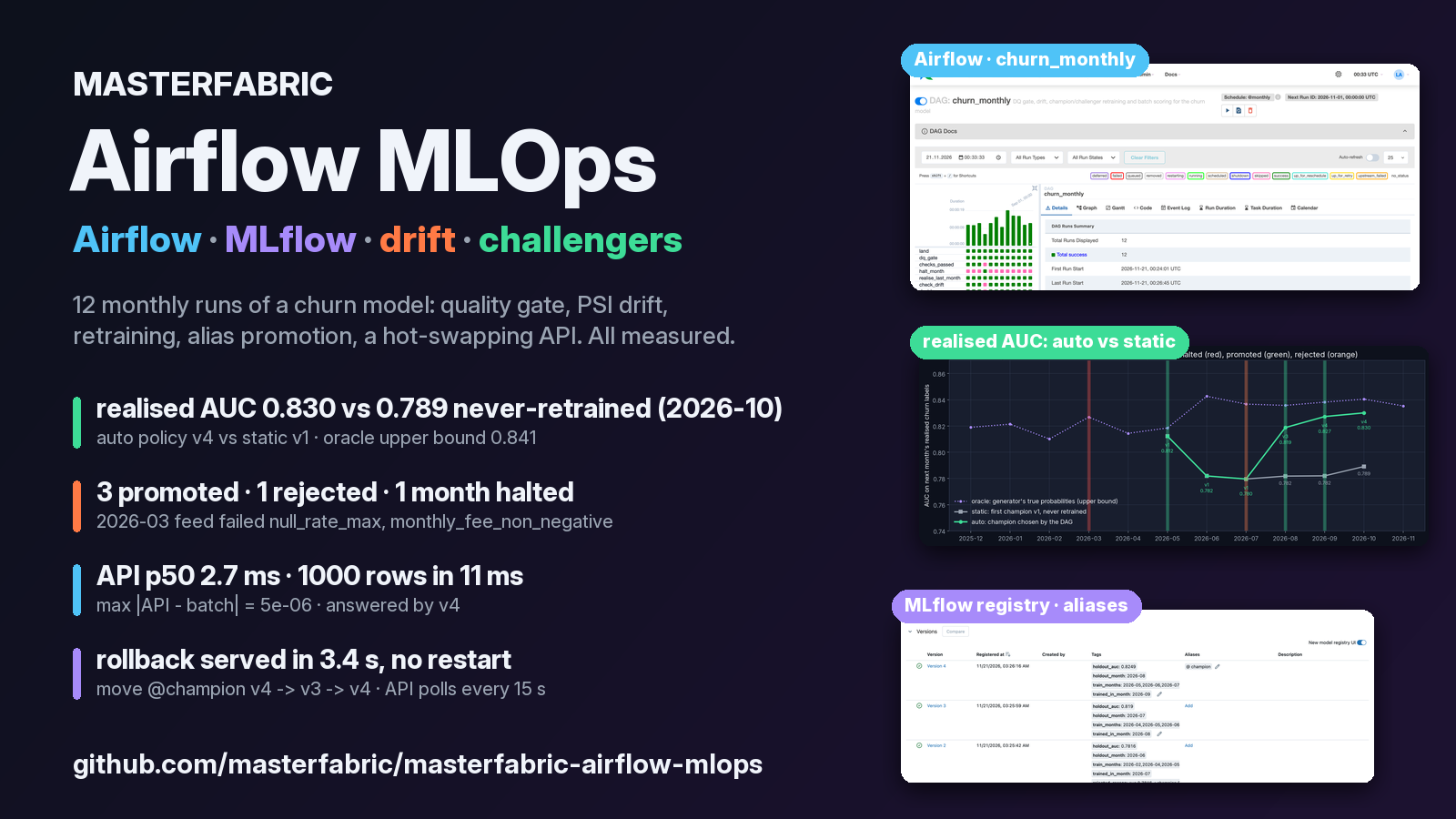
  • Canary rollout: shuffled-label v6 rolled back at 5% (Spearman -0.088); v5 passed 5/25/50% stages, paired delta AUC -0.0007 [-0.0031, +0.0016], and was promoted
  • Rollback: @champion moved from v4 to v3 served after 3.41 s, and back to v4 after 15.27 s (15 s poll), with no restart
  • Drift watcher replay over 40,000 served subscribers: a sustained plan breach (PSI 0.266 at 20,000, sustained at 22,500) retrained v10, which was rejected (0.7816 vs v1 0.7819); with 2026-08 traffic and labels up to 2026-07, v11 was promoted (0.819 vs 0.7796) and served 4.1 s later
Guard v1.2 vs v1.1, fresh held-out set

Simulation of the counts. Each dot is one prompt; amber dots are the misses. v1.1 stays the default.

v1.1 (default)

Attacks18/24 caught · 6 missed
Benign2/20 blocked

v1.2 (optional)

Attacks22/24 caught · 2 missed
Benign4/20 blocked

correctmissed attack / blocked benign

Measured · content/data

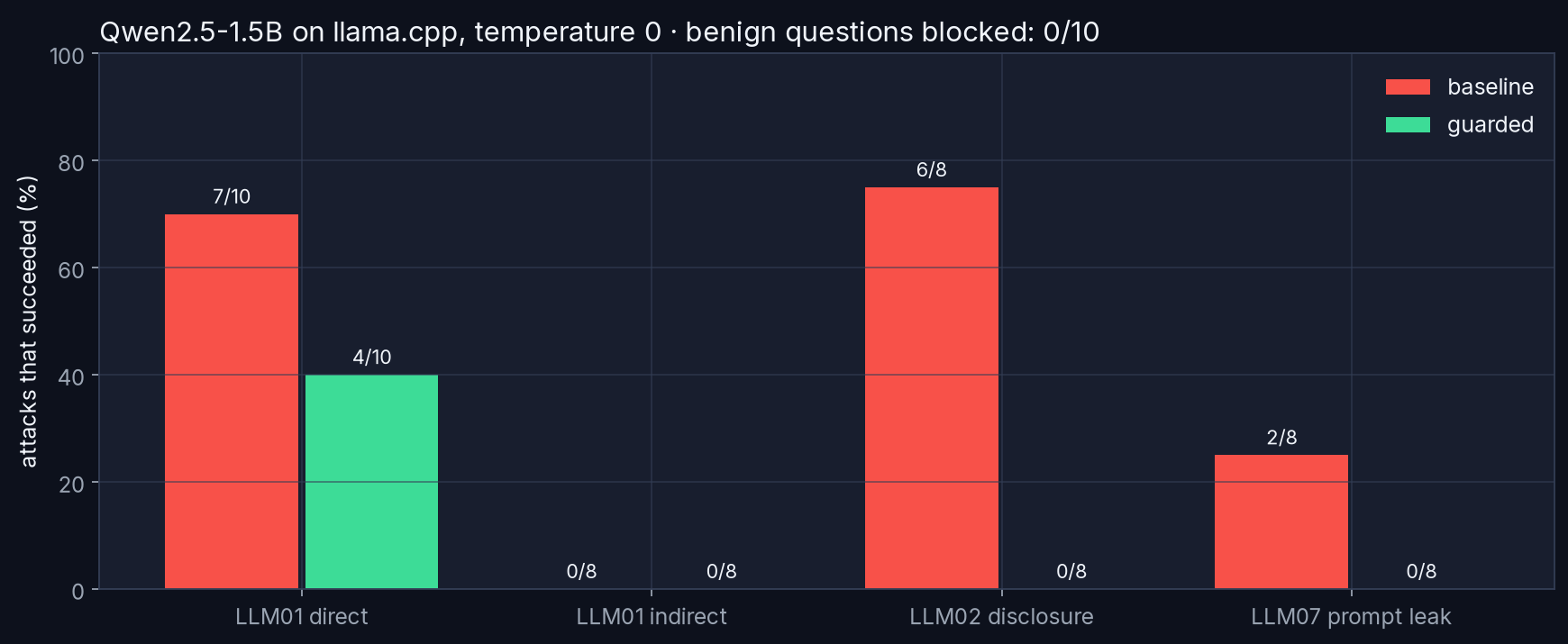
  • Guard v1.2 on a fresh held-out set (24 attacks, 20 hard benign questions): attacks caught 18/24 -> 22/24, benign blocked 2/20 -> 4/20; kept optional, v1.1 stays the default
  • Guard v1.2 (override_narrow at 0.55) on dev: 22/22 attacks caught, 2/39 benign blocked, same as v1.1; on held-out v1 (used to select it): 14/16 caught, 1/14 blocked

Clarify instead of block (guard v3)

Simulation of the counts. Fewer legitimate questions are blocked; the attack result is unchanged.

Block

Legitimate blocked3/12
Attacks shown PWNED3/12

Clarify

Legitimate blocked0/12
Attacks shown PWNED3/12

Measured · content/data

  • Clarify instead of block (guard v3), fresh held-out set: legitimate questions blocked 3/12 to 0/12; attacks shown PWNED 3/12 to 3/12 (unchanged)

Separate measurement, not the clarifier

Direct prompt injection, held-out set: 7/12 to 7/12 (rules) to 1/12 (rules + classifier)

Mode coverage and guidance

Simulation of the measured counts. Guidance shows only the three measured weights; no curve between them is drawn.

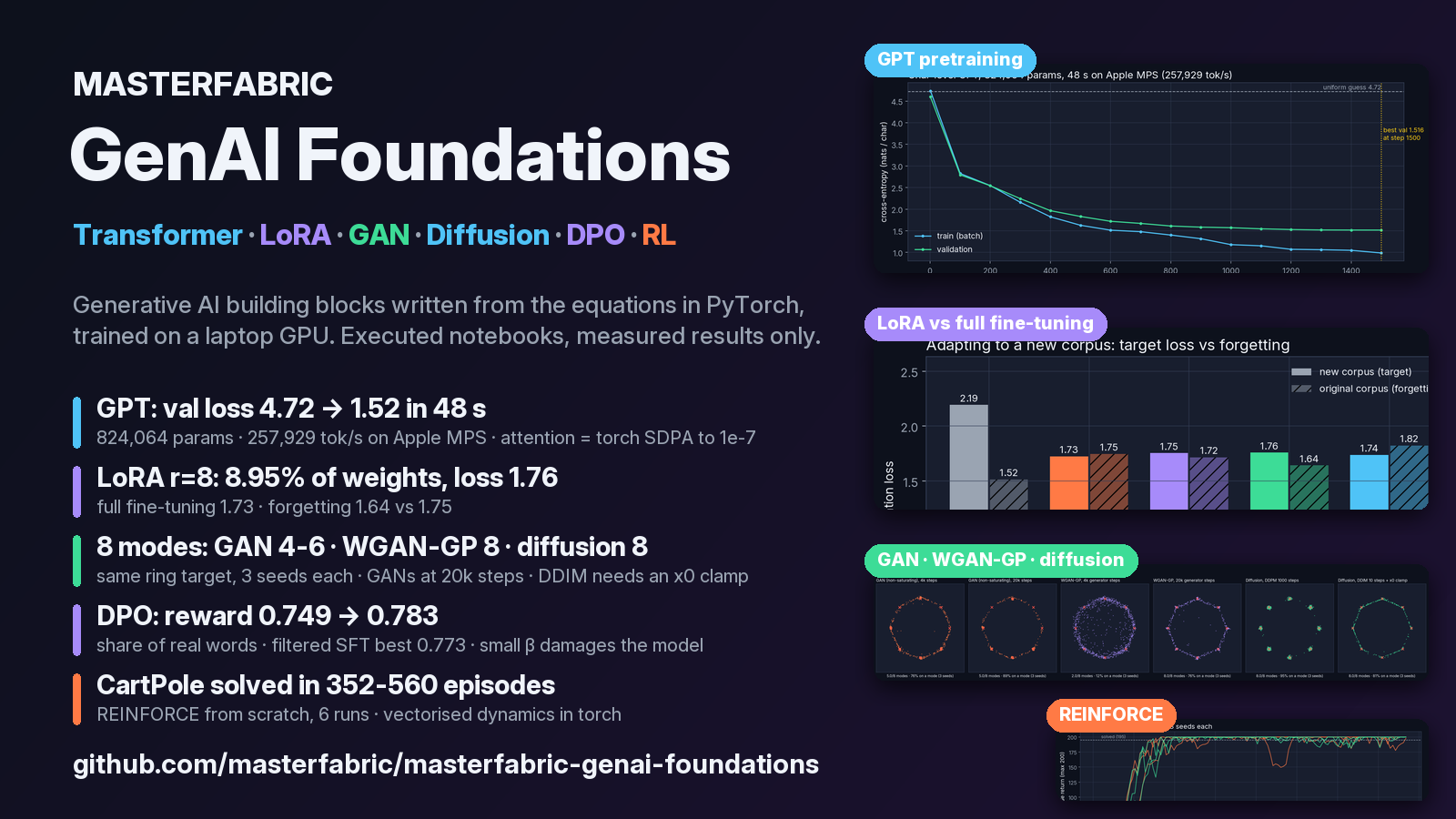
  • GAN
    4–6 of 8
  • WGAN-GP
    8 of 8
  • DDPM
    8 of 8
  • DDIM
    8 of 8
  • GAN: 75-78% on a mode · non-saturating · 3 seeds
  • WGAN-GP: 74-77% on a mode · 20,000 generator steps · 3 seeds
  • DDPM: 95% on a mode · 3 seeds
  • DDIM: 89% on a mode · 20 steps

Measured · content/data

  • The non-saturating GAN covers 4-6 of 8 modes with 75-78% of samples on a mode across 3 seeds.
  • WGAN-GP at 20,000 generator steps covers 8 of 8 modes in all 3 seeds (74-77% on a mode), versus the GAN at 20k still covering only 4-6 of 8.
  • DDPM diffusion on the same ring covers 8 of 8 modes at 95% on a mode (3 seeds); DDIM at 20 steps also reaches 8 of 8 at 89%.

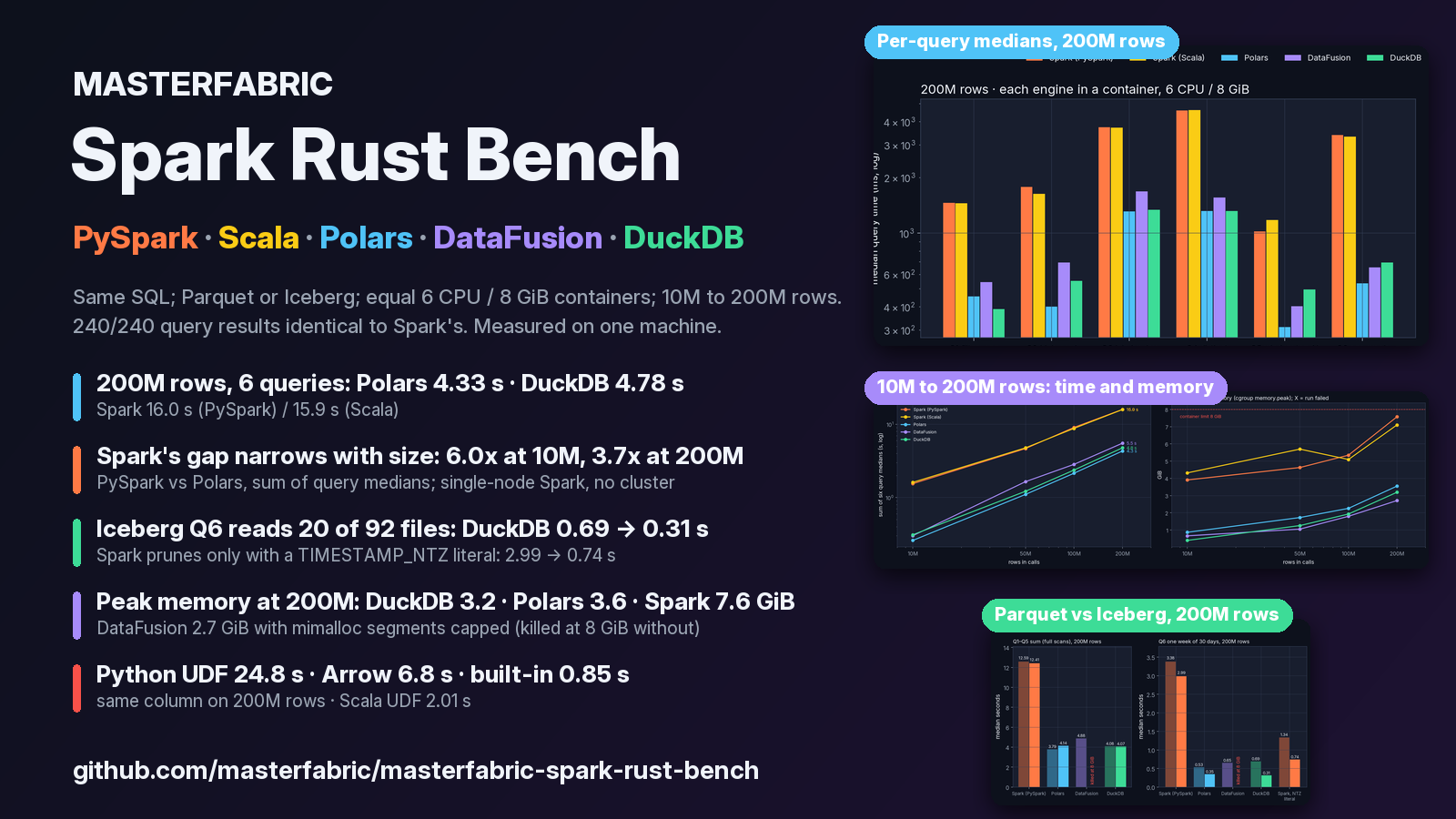
Engine race at 200M rows

Simulation: bars race at one shared speed, so length is proportional to the measured time. The captions are the measured results.

  • Polars
    4.325 s
  • DuckDB
    4.777 s
  • DataFusion
    5.532 s
  • Scala Spark
    15.922 s
  • PySpark
    15.975 s

DataFusion finishes at 200M rows (2,776 MiB capped) · 240/240 results identical.

Measured · content/data

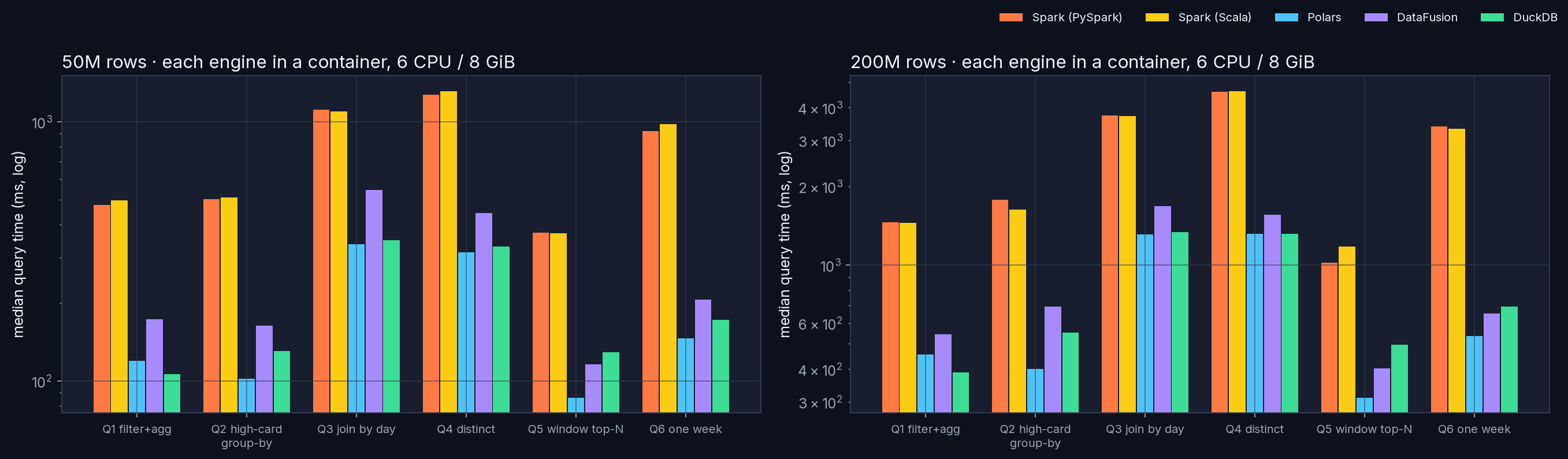
  • Polars ran the same SQL 3.7x faster than PySpark at 200M rows (5.9x at 10M) using less than half the memory; at 200M rows the sum of six query medians was 4.325 s for Polars, 4.777 s for DuckDB, 5.532 s for DataFusion and 15.975 s for PySpark.
  • At 200M rows peak container memory was 7.6 GiB (PySpark), 7.1 GiB (Scala Spark), 3.6 GiB (Polars), 3.2 GiB (DuckDB) and 2.7 GiB (DataFusion, 2,776 MiB with MIMALLOC_TARGET_SEGMENTS_PER_THREAD=2); DataFusion finishes 200M rows in 5.532 s, the least memory of the five engines.
  • 240 of 240 query results were identical to Spark's across 39 runs; one run did not finish (DataFusion reading the 200M-row Iceberg table, killed at the memory limit in the first round) and it is reported, not dropped.

History, first round (not the current result)

DataFusion's memory growth at 200M rows was traced to its bundled mimalloc allocator: with default settings in the first round peak memory was 1,653, 3,575 and 6,652 MiB at 10M, 50M and 100M rows and the run was killed at 8,192 MiB at 200M, while MIMALLOC_TARGET_SEGMENTS_PER_THREAD=2 gave 679, 1,080, 1,841 and 2,776 MiB with the same query times.

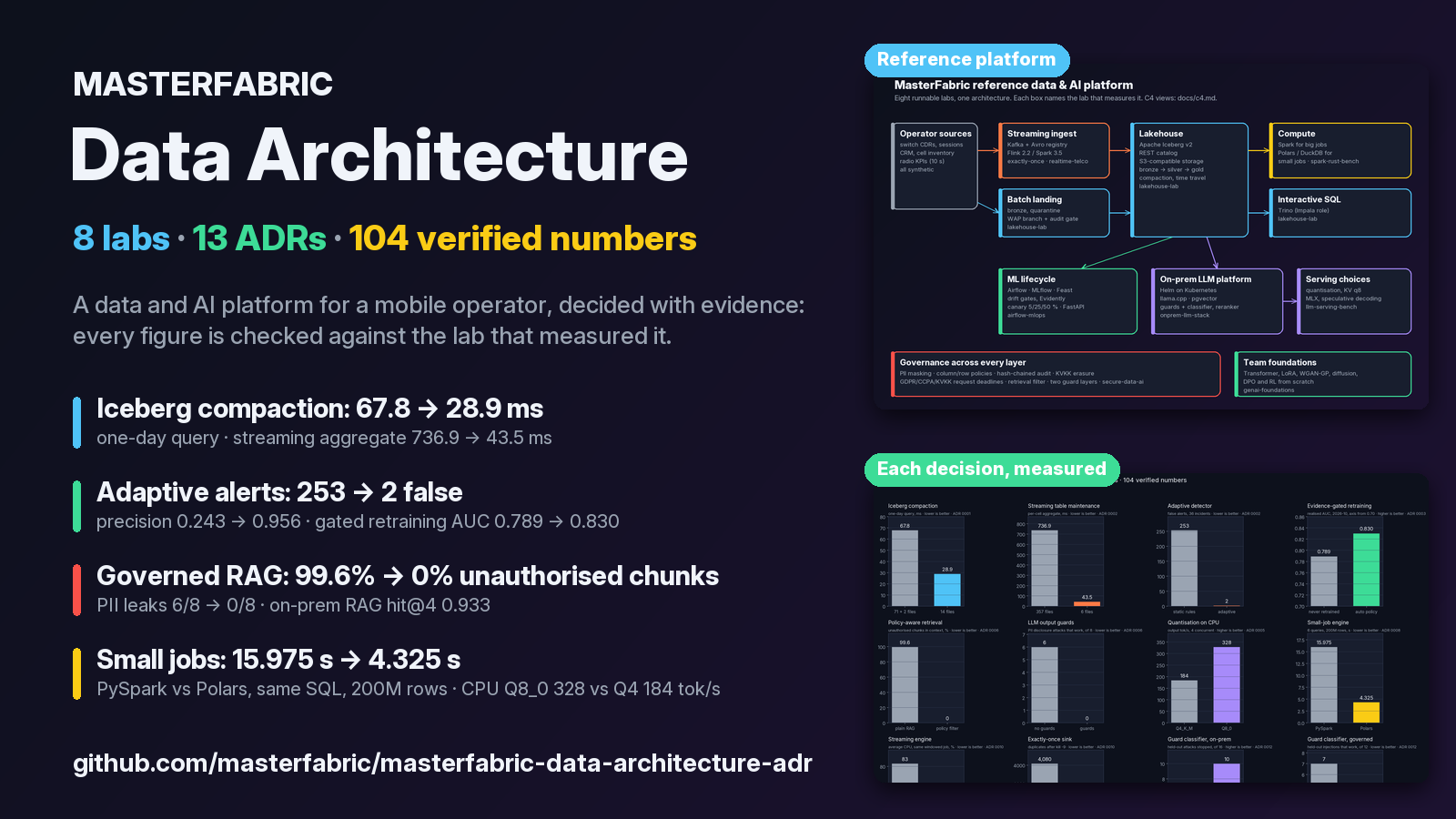
ADR 0009: where on-prem starts to win

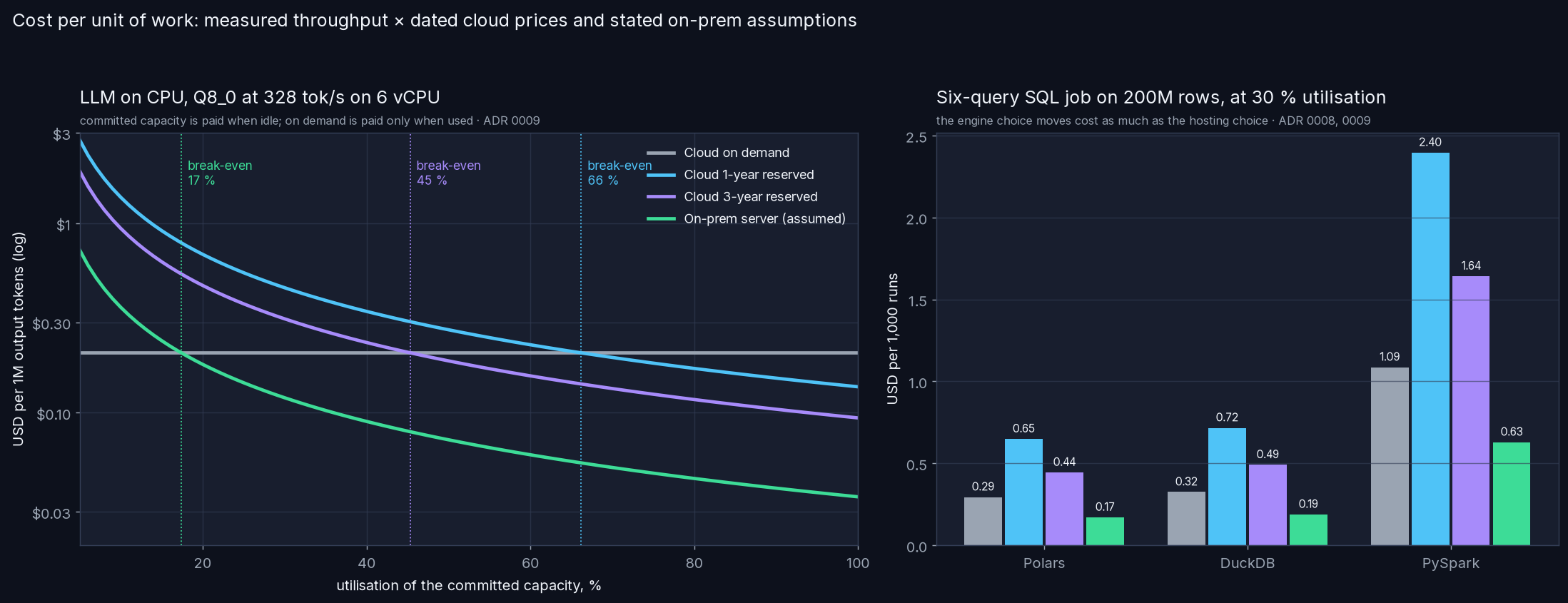
Simulation of the quoted points on a 0–100% utilisation axis. Only the 17% break-even and the 30% price quote were measured; no cost curve is drawn.

0%utilisation100%

Above 17% utilisation on-prem beats on-demand cloud. At 30% utilisation the Q8 LLM costs $0.207 vs $0.120 per 1M tokens, quoted in the order of the source sentence.

Measured · content/data

  • ADR 0009 cost model: on-prem beats on-demand cloud above 17% utilisation; Q8 LLM $0.207 vs $0.120 per 1M tokens at 30% utilisation.

Privacy context

CCPA, GDPR and KVKK: how a request flows, and when a response is due

All three laws let people ask about their data and ask for it to be erased. They do not treat consent identically, and the deadlines below are general rules that can come with conditions.

How a request typically flows

  1. A person applies to the organisation.
  2. The controller (under CCPA, the “business”) receives the request.
  3. Identity is verified.
  4. The request is processed: access, erasure, or consent / opt-out.
  5. A response is due within the period shown below. It can come with conditions and, where the law provides, an extension.

What each law calls it

GDPR
Data subject rights, including access, erasure, and withdrawal of consent as a legal basis.
CCPA
Consumer rights, including the right to know / access, the right to delete, and the right to opt out of sale or sharing. It is not a general consent-first rule.
KVKK
İlgili kişi başvurusu (application by the data subject). Article 11 sets out the data subject’s rights; Article 13 governs the application to the controller, including the 30-day period.
SimulationIllustrative of statutory time limits. Not measured data, and not how any organisation performs.
GDPREuropean Union

Right of access

1 calendar month (28-31 days)day 30

Extension available in some cases; toggle to show.

  1. Receive (reached)
  2. Verify identity (reached)
  3. Process (reached)
  4. Respond (reached)
CCPACalifornia, USA

Right to know / access

45 daysday 45

Extension available in some cases; toggle to show.

  1. Receive (reached)
  2. Verify identity (reached)
  3. Process (reached)
  4. Respond (reached)
KVKKTürkiye

Application to learn about and access data

30 daysday 30

30 days is the general rule (Art. 13); no extension is shown.

  1. Receive (reached)
  2. Verify identity (reached)
  3. Process (reached)
  4. Respond (reached)

Steps are a general teaching model of how a request often flows, not a statutory checklist; actual procedures vary and have conditions. The clocks run on a short illustrative timescale. GDPR’s one calendar month is 28-31 days and is drawn as 30 days; its extension is up to 2 further months (drawn as 60 days at most), not a guaranteed extra period. KVKK has no generally stated extension of that kind.

Measured in the lab · synthetic data

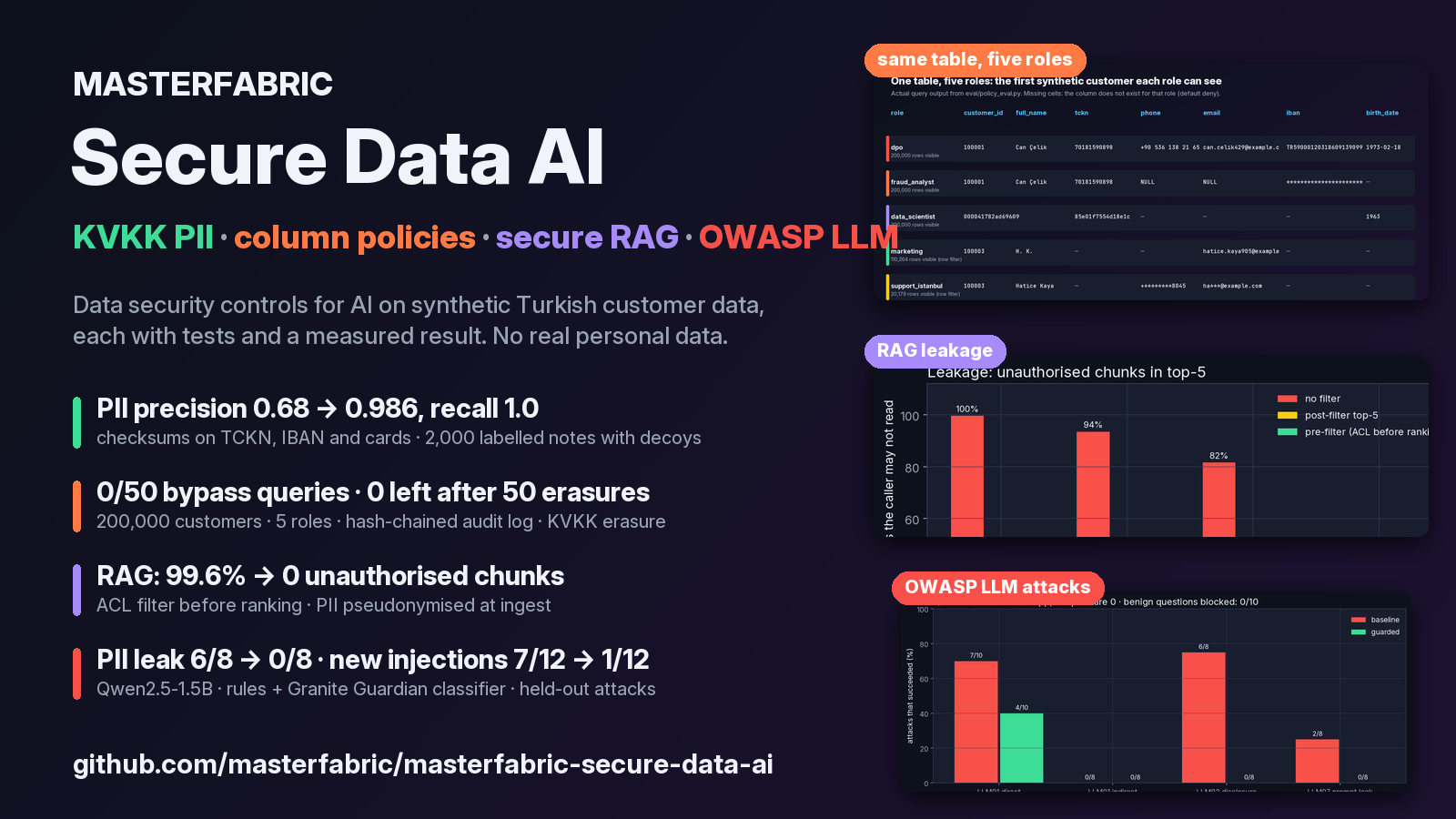
“KVKK erasure, 50 of 200,000 subjects: 0 residual rows outside 100 retained invoice rows; other rows unchanged; p50 108 ms.”

A measured erasure run in the secure-data-ai lab, not a compliance claim. The 108 ms is lab processing time, not a KVKK response deadline. secure-data-ai →

Measured in the lab · data-subject requests · synthetic data

540/540 requests completed on time (GDPR, CCPA and KVKK × access, erasure, consent withdrawal) over 200,000 customers, with 0 residual rows outside 360 retained invoice rows.

Latency per request type in milliseconds, p50 and p95
Requestp50p95
Access2.1 ms2.7 ms
Consent withdrawal1.5 ms2.1 ms
Erasure117 ms141 ms
  • Identity: 820 attempts (280 genuine, 540 impostor), 0 false accepts, 0 false rejects. The attempts were constructed to the rules, so this shows the rules behave as written, not how they fare against real impostors.
  • Worked example, request received 2028-01-31: GDPR due 2028-02-29 (extended 2028-04-30); CCPA 2028-03-16 (extended 2028-04-30), opt-out 2028-02-21; KVKK 2028-03-01.

Lab processing time, not a response deadline. Deadline modelling is simplified: day 0 is the receipt day, a GDPR month is clamped to month end, weekends and holidays are not rolled, and no KVKK extension is modelled.

Read the comparison ↗Lab ADR 0008 ↗README section 8 ↗Platform ADR 0013 ↗secure-data-ai →

This is not legal advice. It is high-level teaching context placed next to a measured lab, not advice about anyone’s obligations. Check the current text of each law, or ask a lawyer.

Work

The Repositories

03 · 3546e6f · 2026-11-23

MasterFabric · Airflow MLOps

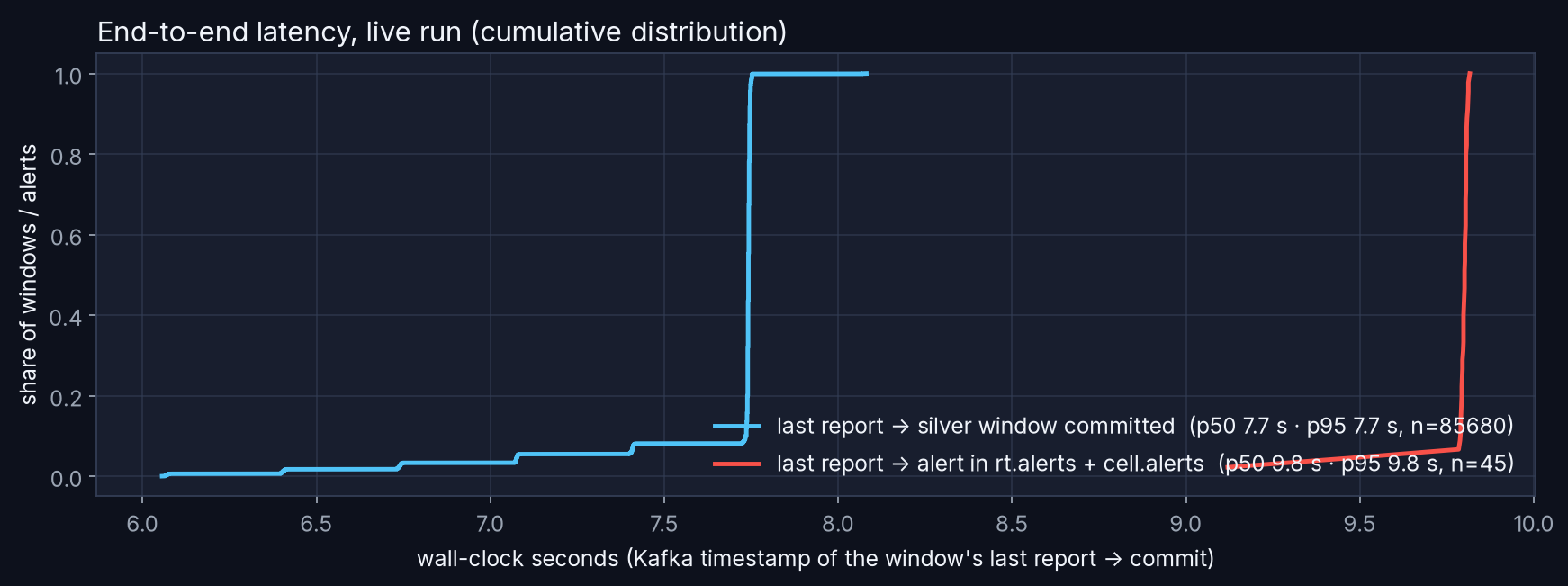
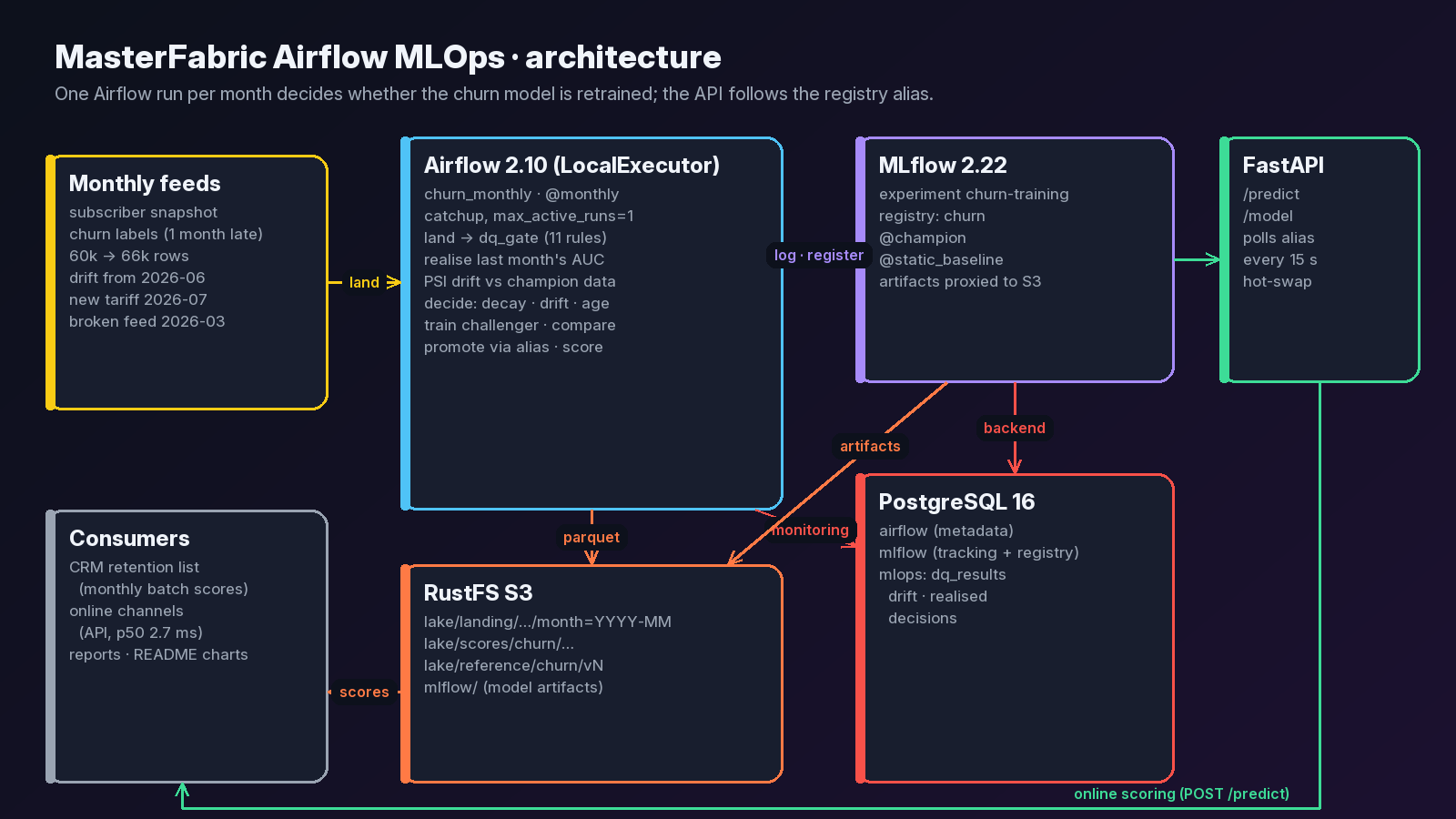
Replays a year of telco churn modeling on Airflow, MLflow, Evidently and Feast with measured retraining results.

Read the entry →GitHub
05 · 83af7fe · 2026-11-23

MasterFabric · LLM Serving Bench

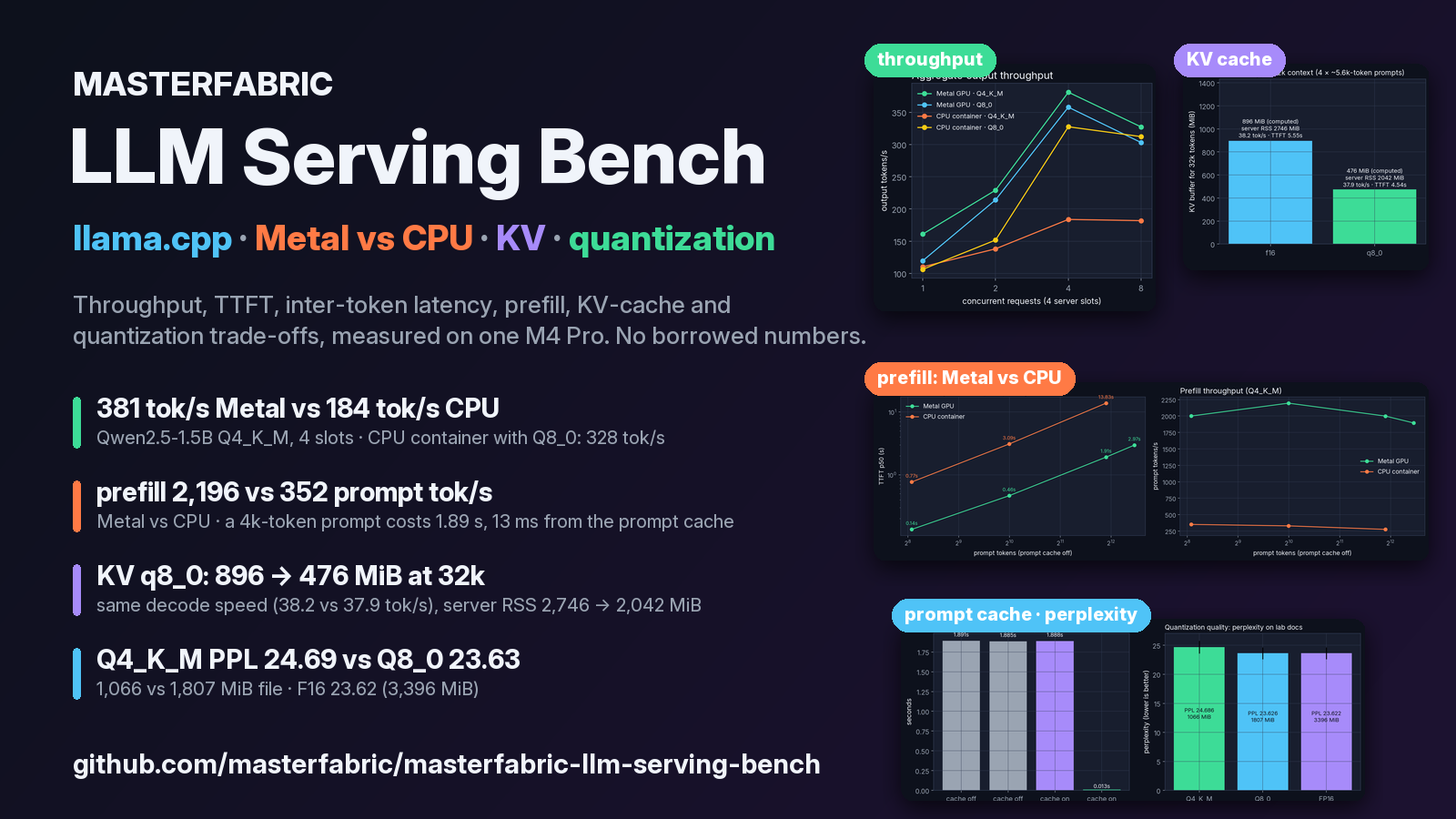
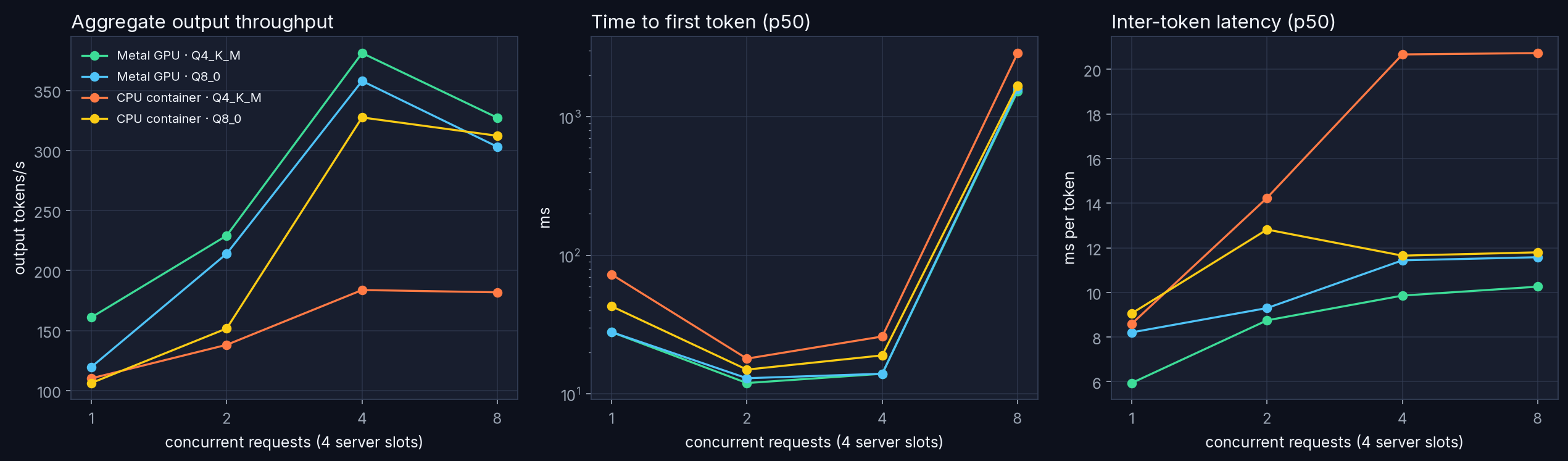
Measured LLM serving benchmarks comparing llama.cpp and MLX on Apple Silicon across quantization, concurrency, context and speculative decoding.

Read the entry →GitHub
06 · 8ef6054 · 2026-11-23

MasterFabric · Secure Data AI

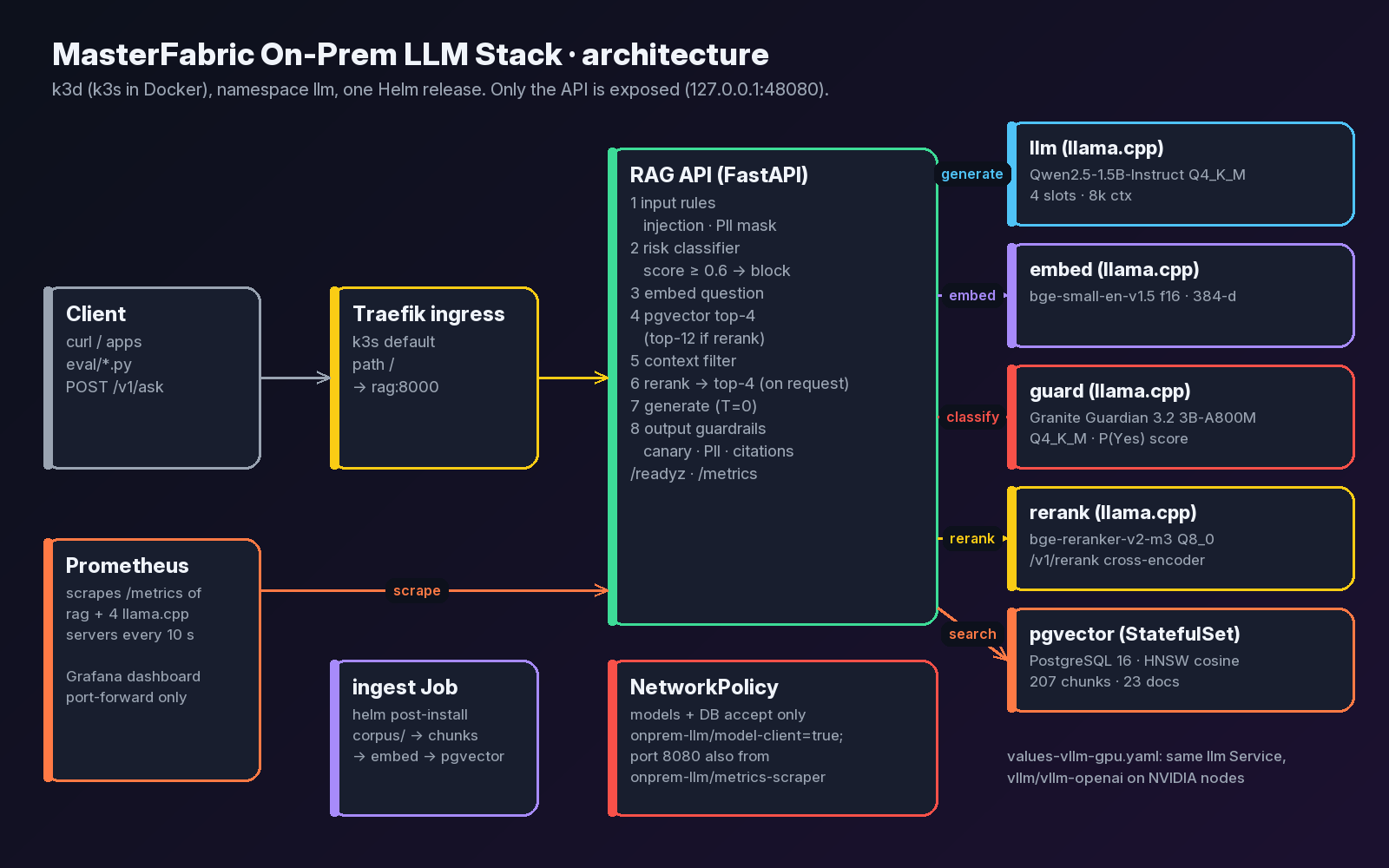
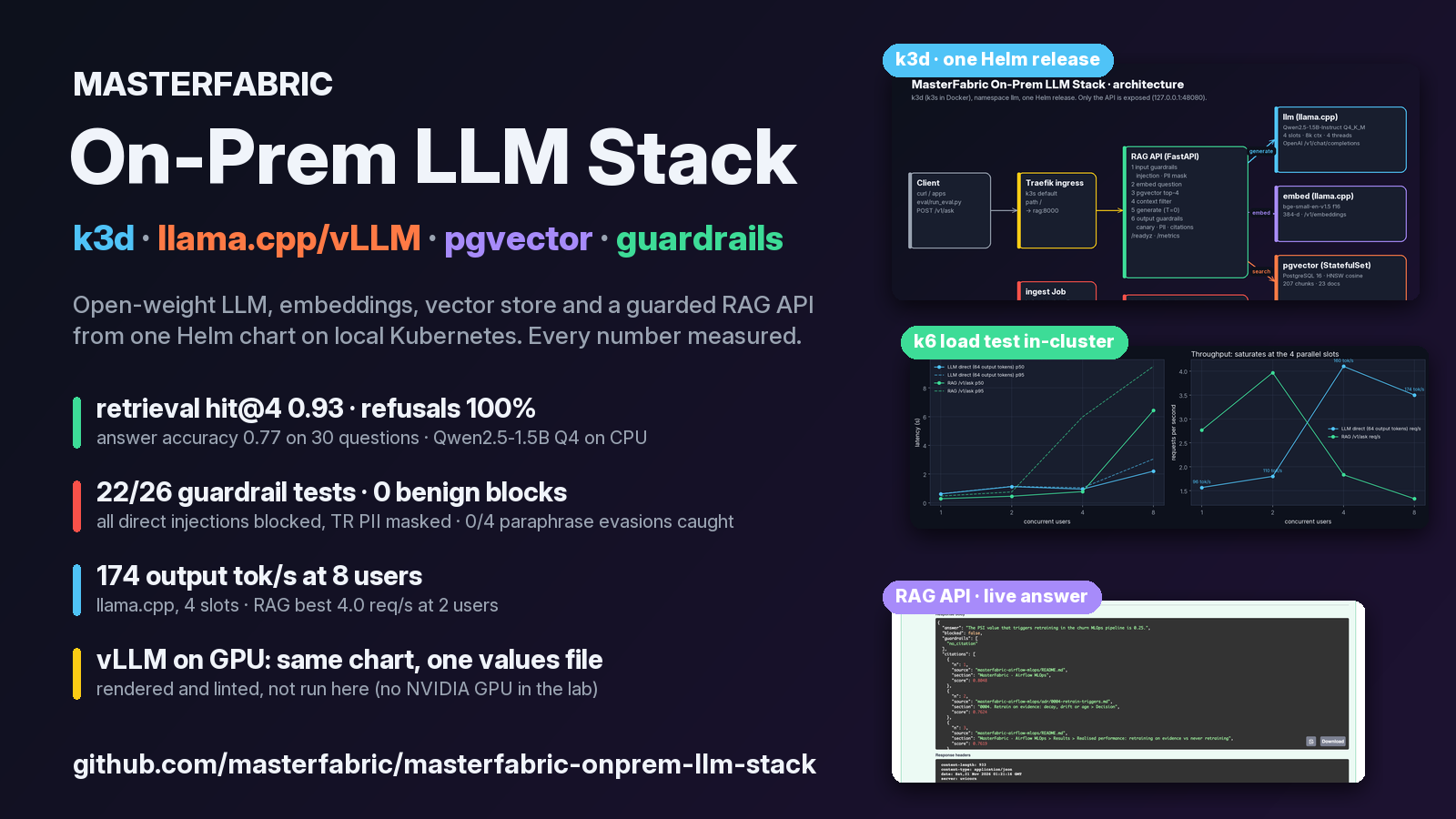
Data security controls for AI, measured on synthetic Turkish data: PII masking, column policies, secure RAG and OWASP LLM guardrails.

Read the entry →GitHub
07 · 9e3b863 · 2026-11-23

MasterFabric · GenAI Foundations

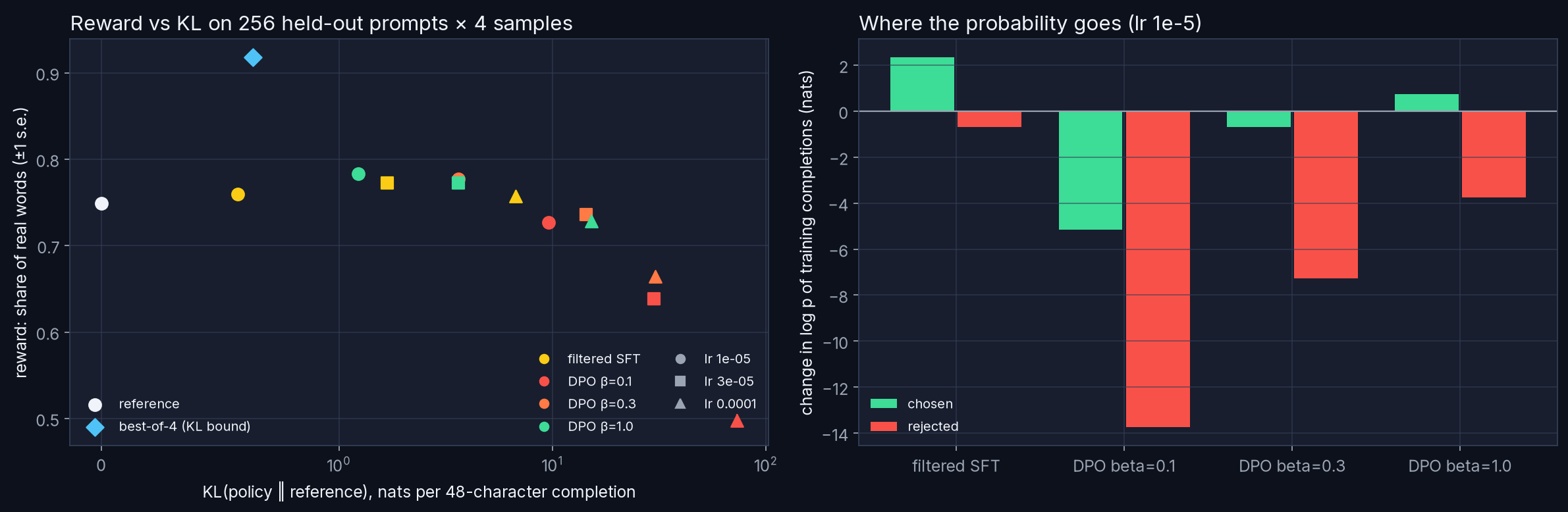
From-scratch PyTorch implementations of transformer, LoRA, GAN, WGAN-GP, diffusion, classifier-free guidance and DPO with measured results.

Read the entry →GitHub
08 · 361bb4a · 2026-11-23

MasterFabric Spark Rust Bench

Benchmarks five SQL engines on identical queries over 10M to 200M synthetic telco records, including Iceberg table reads.

Read the entry →GitHub
09 · 6b02e27 · 2026-11-23

MasterFabric Data Architecture

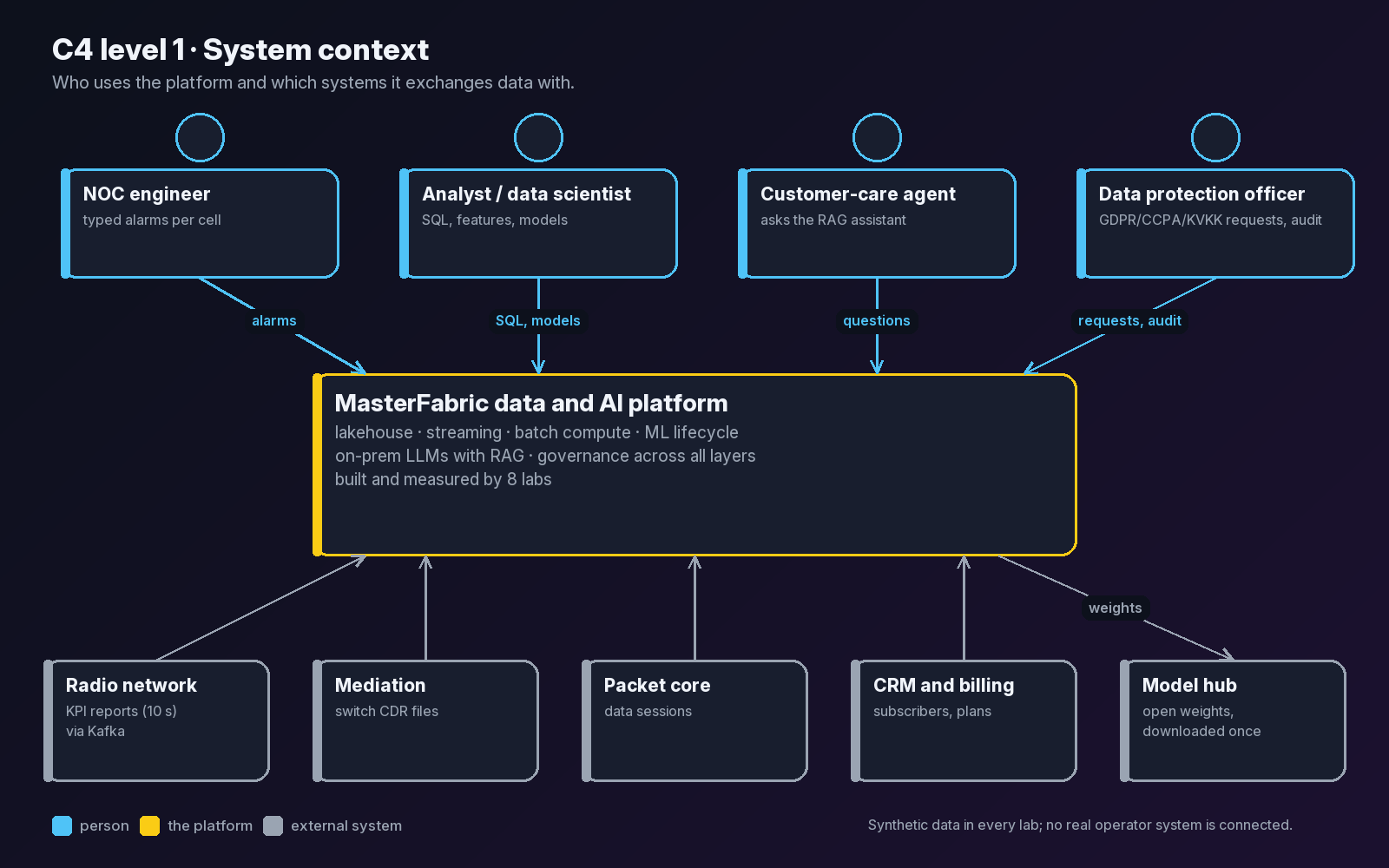
Ties eight MasterFabric labs into one platform with thirteen verified ADRs, C4 diagrams, and a cost model.

Read the entry →GitHub

Figures on this page reflect each repository’s main branch at copy time (latest snapshot: 2026-11-23). They can be refreshed whenever the source repositories change.