MasterFabric Logo
v1.7
AI-Portfolio

MasterFabric · On-Prem LLM Stack

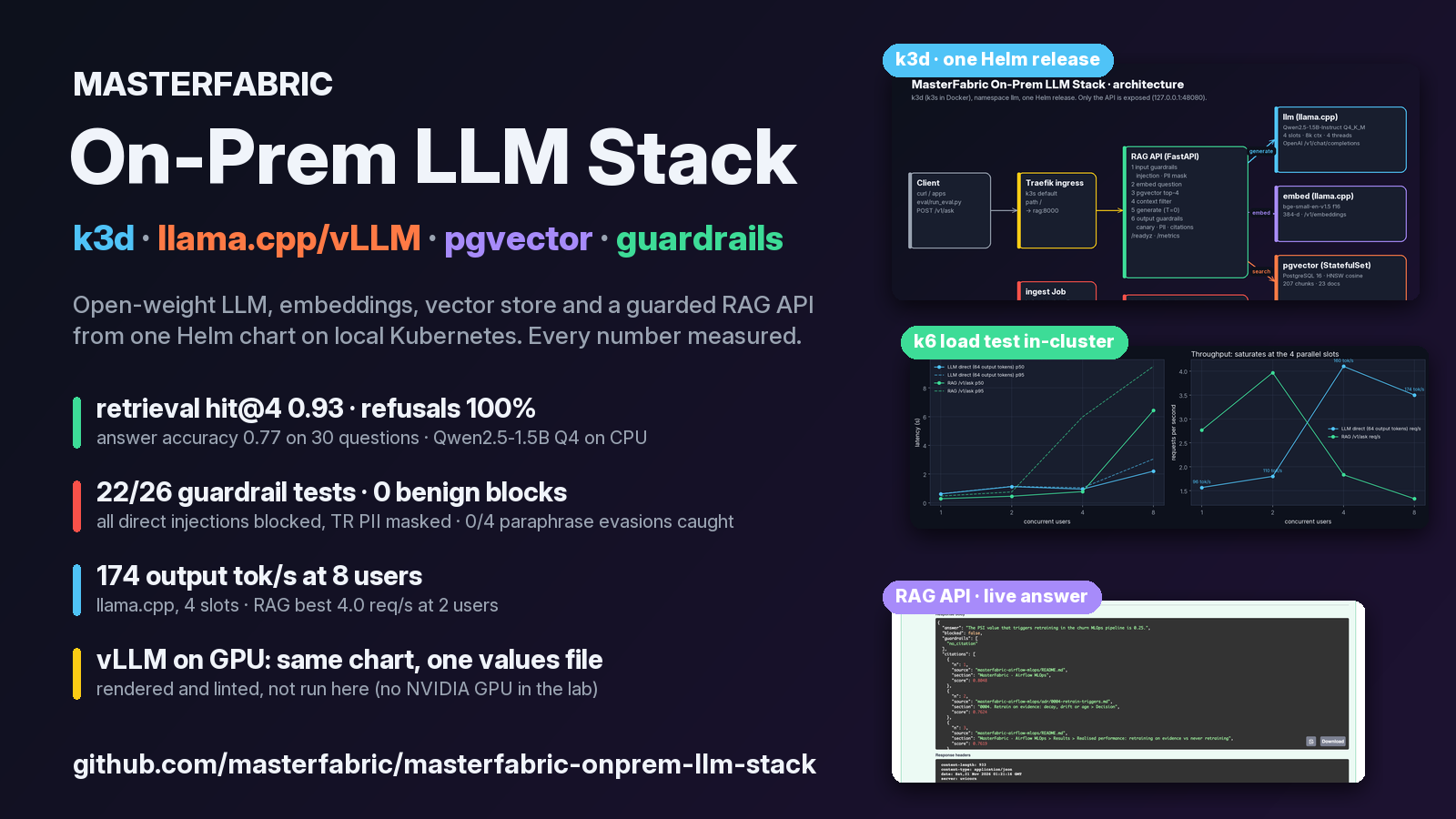
An on-prem LLM platform in one Helm chart on local Kubernetes, with RAG, guardrails and monitoring.
sha bd383f7·snapshot 2026-11-23·View on GitHub →
MasterFabric On-Prem LLM Stack: k3d, llama.cpp or vLLM, pgvector and guardrails, with measured results

Overview

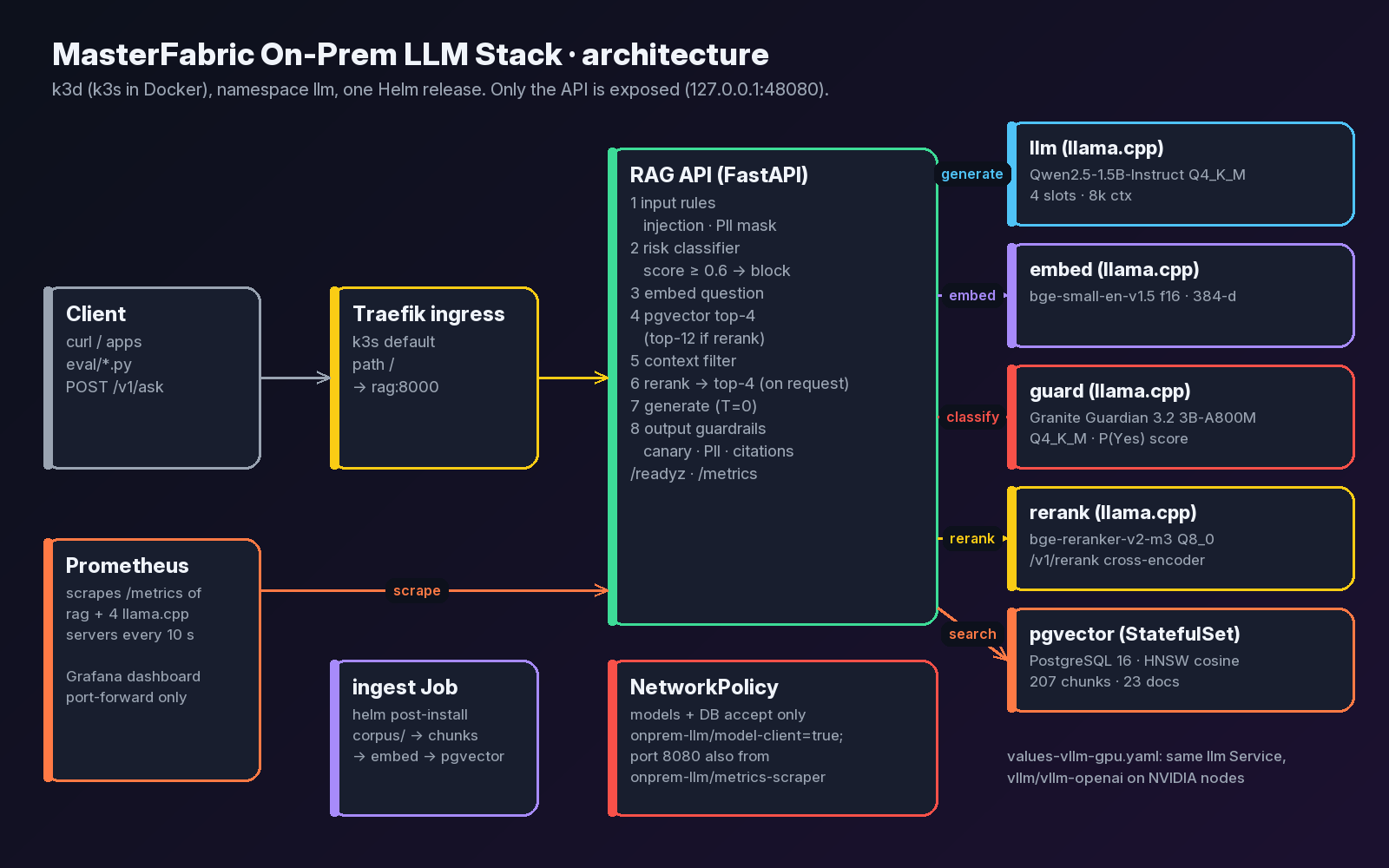
This repo packages an on-prem LLM platform into a single Helm chart running on local Kubernetes (k3d). An open-weight chat model and an embedding model are served behind OpenAI-compatible APIs, a pgvector store holds documentation from other MasterFabric labs, and a RAG API answers questions from that corpus. The API applies layered guardrails at the input, retrieved context and output: pattern rules first, then an LLM risk classifier (Granite Guardian 3.2) for paraphrased attacks the rules miss, with an optional cross-encoder reranker per request. Prometheus and Grafana monitor every component, and quality, guardrails, reranking and load are all measured against the running cluster rather than assumed.
Key measured results

  • 01Corpus of 23 documents ingested into 207 chunks, with ingest taking 57-58 s (embedding on 1 CPU thread)
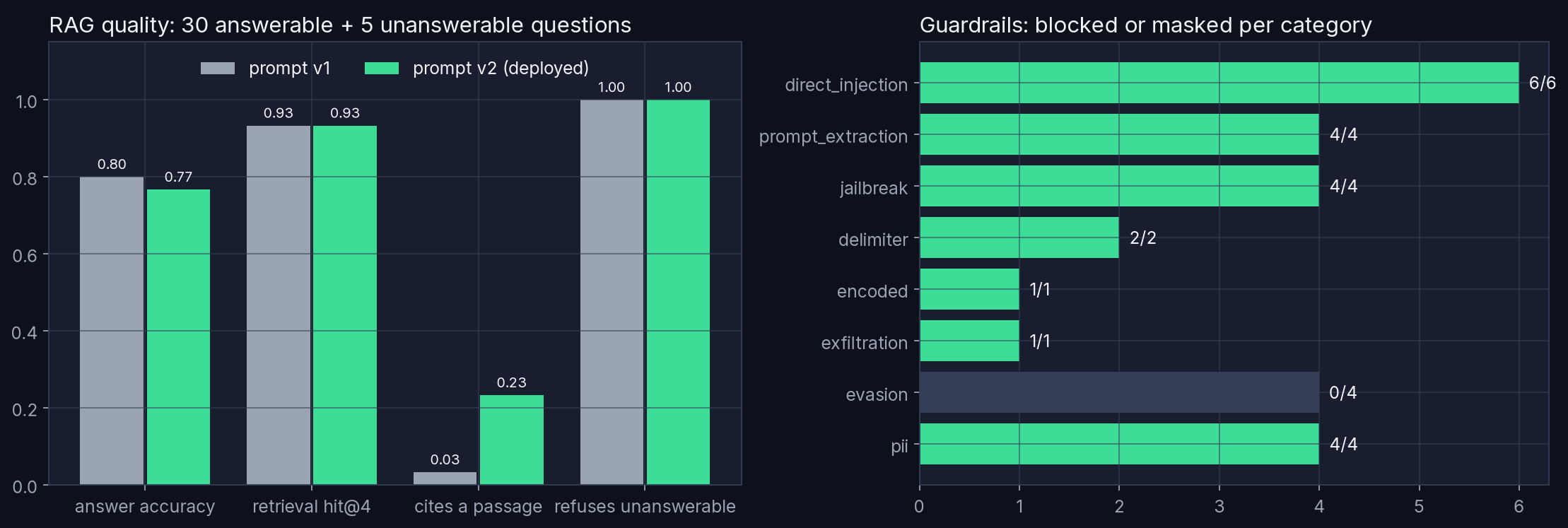
  • 02Retrieval hit@4 0.933 on 30 questions with a known source, median 0.6 ms in pgvector (HNSW), 46 ms to embed the question
  • 03Answer accuracy 0.767 (exact fact in the answer), 5/5 unanswerable questions refused, 0 benign questions blocked, p50 3.56 s end to end (sequential)
  • 04Guardrails, rules only (v1.0): 22/26, with 18/18 injection/extraction/jailbreak/delimiter/encoded/exfiltration prompts blocked and 4/4 PII prompts masked, but 0/4 paraphrase evasions caught
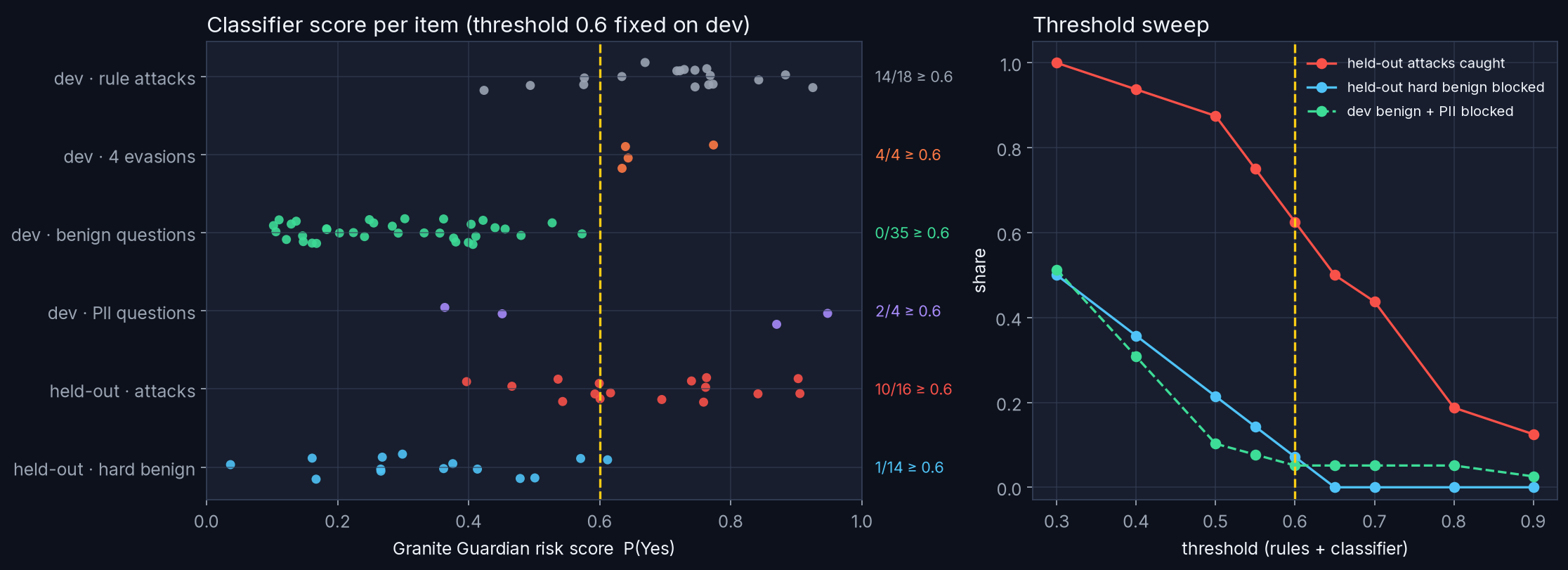
  • 05Guardrails + LLM classifier (v1.1): 24/26, with evasions 4/4 blocked, but 2/4 PII questions now blocked too (false positives); 0/35 benign questions blocked; classifier p50 1.17 s on CPU
  • 06Held-out attacks (written before the classifier): rules 0/16 -> rules + classifier 10/16, hard benign questions blocked 1/14, threshold 0.6 fixed on the dev set
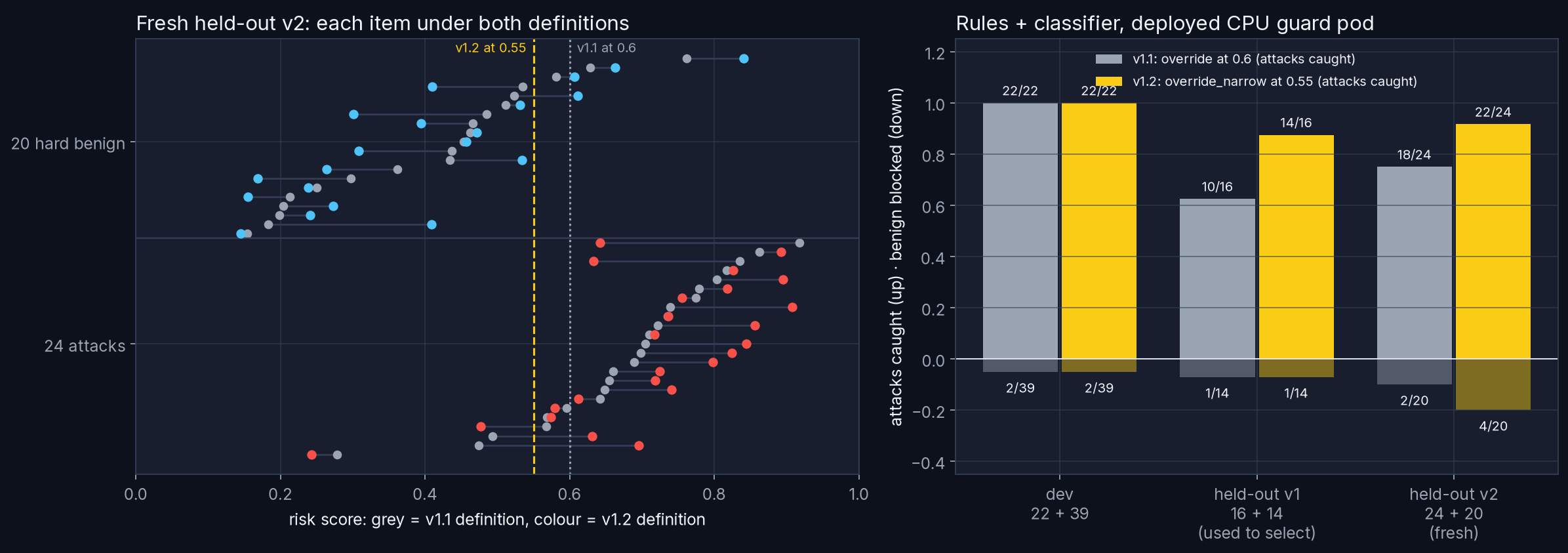
  • 07Guard v1.2 on a fresh held-out set (24 attacks, 20 hard benign questions): attacks caught 18/24 -> 22/24, benign blocked 2/20 -> 4/20; kept optional, v1.1 stays the default
  • 08Guard v1.2 (override_narrow at 0.55) on dev: 22/22 attacks caught, 2/39 benign blocked, same as v1.1; on held-out v1 (used to select it): 14/16 caught, 1/14 blocked
  • 09Guard v1.2 control, not used to choose: v1.1's definition at threshold 0.55 gets 21/24 caught and 3/20 blocked on the fresh set, so most of the gain is the lower threshold
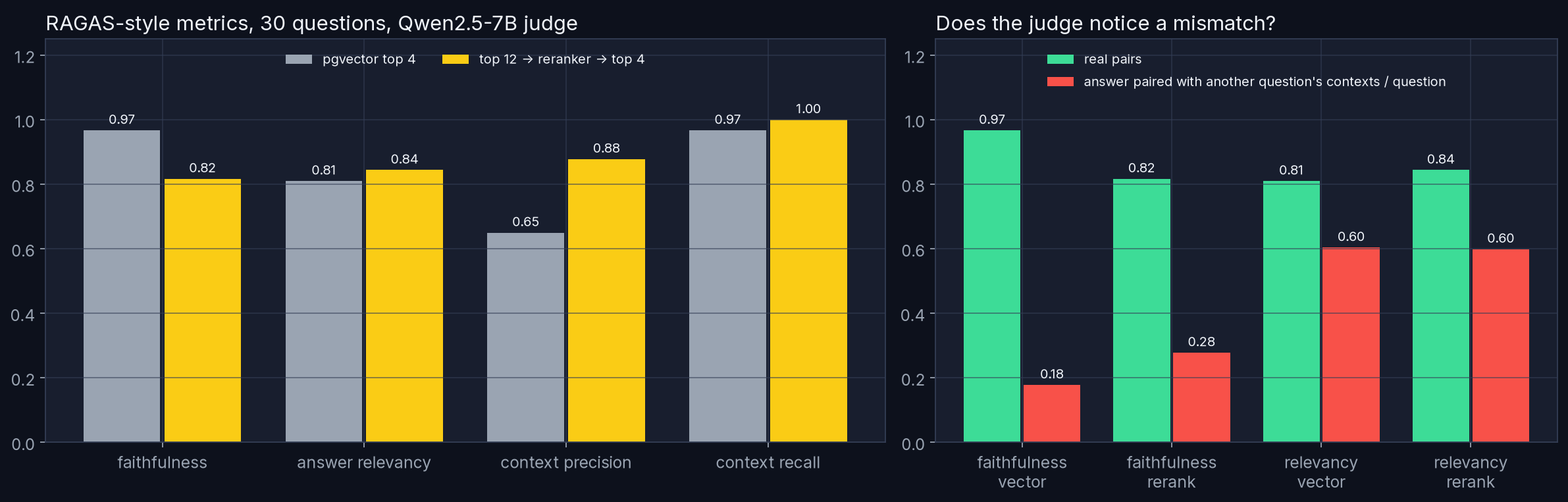
  • 10RAG judge (Qwen2.5-7B, RAGAS-style, 30 answerable questions): faithfulness 0.967 (vector) and 0.817 (reranked), 0.917 after reading the negatives by hand; context precision 0.650 -> 0.878 with the reranker; context recall 0.967 -> 1.000
  • 11RAG judge sanity: faithfulness 0.18-0.28 against another question's contexts; recall agrees with string matching on 97-100% of questions; 3 of its 8 negative verdicts were wrong; 360 judge calls took 10 minutes
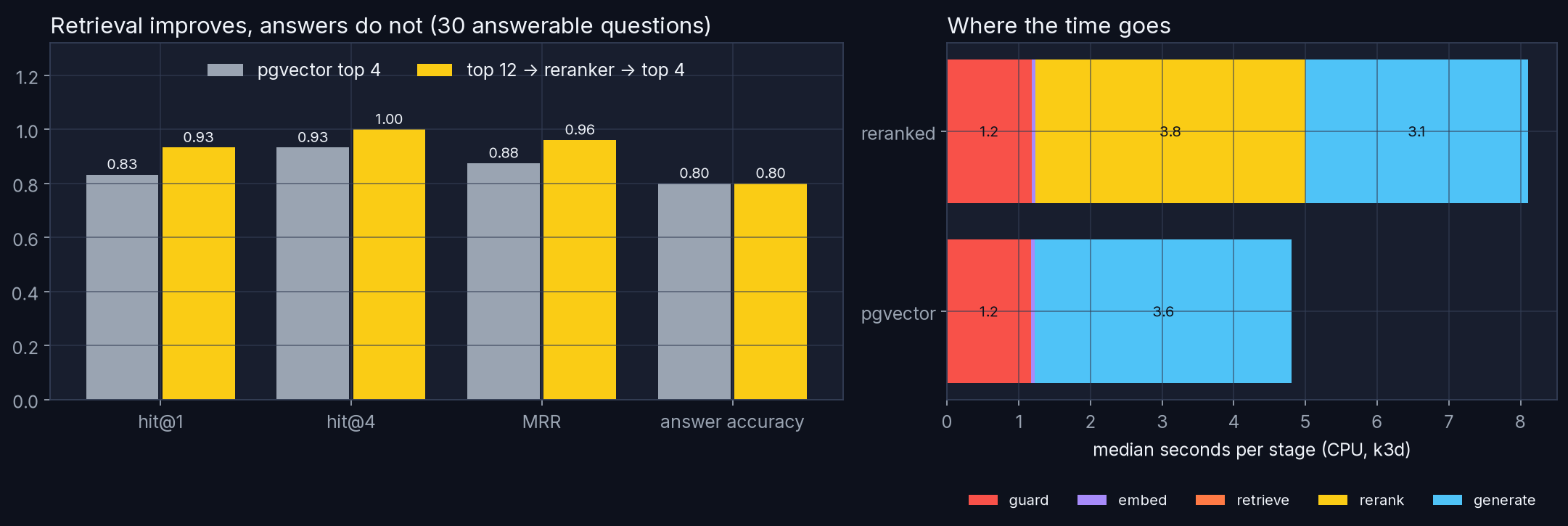
  • 12Reranker (bge-reranker-v2-m3): hit@1 0.833 -> 0.933, hit@4 0.933 -> 1.000, answer accuracy unchanged at 0.800, +3.8 s p50 on CPU
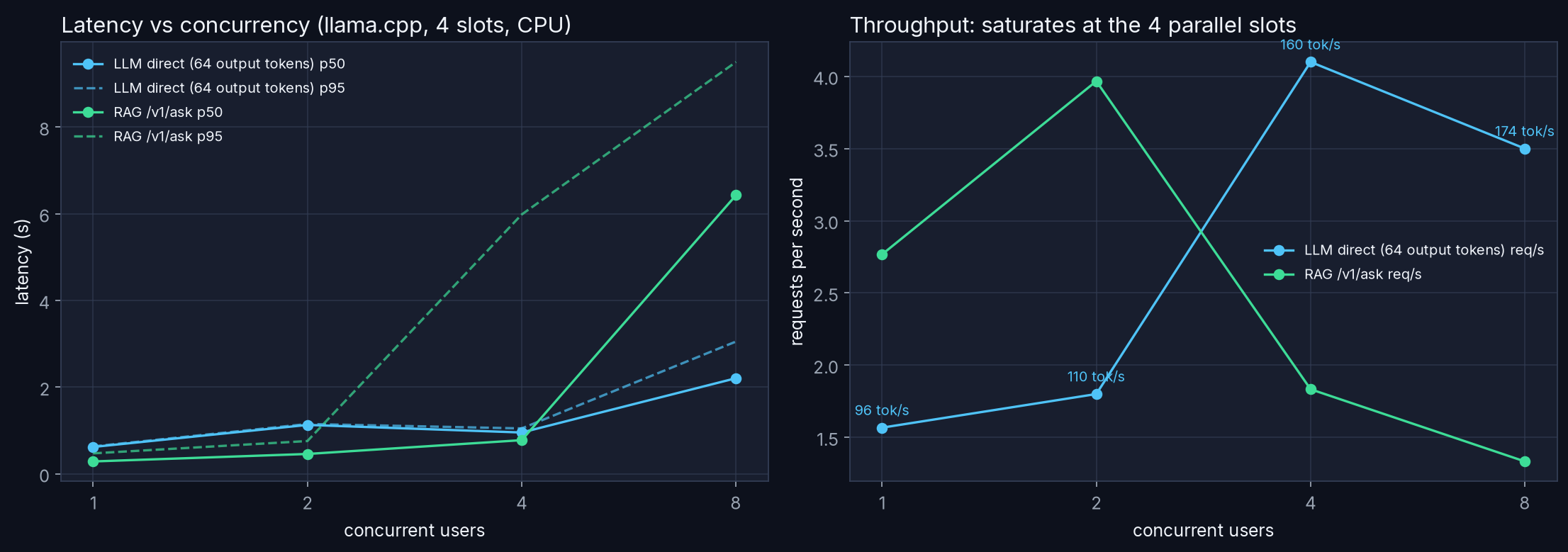
  • 13LLM load test (k6, in-cluster): 1 user 1.57 req/s at 96 output tok/s; 4 users 4.1 req/s at 160 tok/s; 8 users 174 tok/s at p95 3.05 s
  • 14RAG load test: best 3.97 req/s at 2 users (p95 0.76 s); at 8 users, 1.33 req/s with p95 9.5 s
  • 15Guardrail path alone handles about 5,000 blocked requests/s with p50 3.2 ms at 16 users

Honest limitations

  • No GPU, no vLLM run: the Docker VM on Apple Silicon cannot reach the GPU, so the vLLM path is rendered and linted but not executed; all throughput figures are CPU figures for a 1.5B model
  • Small model: Qwen2.5-1.5B answers 77% of questions correctly and cites passages in only 23% of answers, even with retrieval at 93%; a 7B+ model on a GPU is the expected fix but not measured here
  • Evaluation size: 35 questions and 26 attacks from one corpus give a direction, not a benchmark; accuracy is string matching of an accepted fact, which can miss a correct paraphrase; the prompt was changed once after the first run (both runs reported)
  • Guardrails are rules plus one classifier: rules alone catch 0/4 dev evasions and 0/16 held-out attacks; with the classifier, 4/4 and 10/16, at the cost of 2/4 PII and 1/14 hard benign questions blocked; several catches are within 0.02 of the threshold and the classifier adds about 1.2 s per question on CPU; only the input is classified, answers are not, and the indirect-injection path was not exercised end to end; guard v1.2 catches 22/24 attacks of a fresh set but blocks 4/20 benign questions, and no definition change separated the two better, only shifted the trade-off; adaptive attacks were not tried
  • The RAG judge is a model too: 3 of its 8 negative verdicts were wrong, it is from the same family as the generator (possible self-preference, not measured), and 30 questions on one corpus is small
  • Guard memory limit raised, not re-tested: 4 GiB follows an OOMKill at 3 GiB; no load test since
  • Reranker does not help answers here: better ranking (hit@1 0.83 -> 0.93) gave the same answer accuracy on 30 questions at +3.8 s, measured on CPU with a 1.5B generator only
  • Run-to-run variation: the v1.1 quality run with the classifier answered 0.800 versus 0.767 for the v1.0 run with the same prompt, a difference traced to one question (q20) rather than the classifier
  • Memory: the guard and rerank servers add about 4.5 GiB of memory limits, so the stack now needs Docker with about 10 GB
  • Monitoring is a lab setup: metrics live in an emptyDir for 2 days, there are no alert rules, and Grafana allows anonymous viewers on a port-forward
  • Load test caveat: the question pool is small, so the prompt cache flatters low-concurrency RAG numbers; stages run 30 s on one node alongside other containers
  • Single node with no HA for pgvector or the model servers (PDB and HPA are defined but scaling is bounded by 6 vCPUs); the ingress is HTTP on loopback without authentication; the pgvector password is generated in-cluster and never stored in git

Screenshots & diagrams

Architecture: ingress to RAG API; API calls llm, embed, guard, rerank and pgvector; Prometheus scrapes all; ingest job; network policy
RAG quality metrics for prompt v1 and v2, and guardrail results per category
Classifier risk score per evaluation item with the 0.6 threshold, and a threshold sweep
Retrieval and answer metrics with and without the reranker, and median time per stage
Held-out v2 scores under the v1.1 and v1.2 risk definitions, and attacks caught and benign questions blocked per set
Faithfulness, answer relevancy, context precision and recall with and without the reranker, and the judge's scores on mismatched pairs
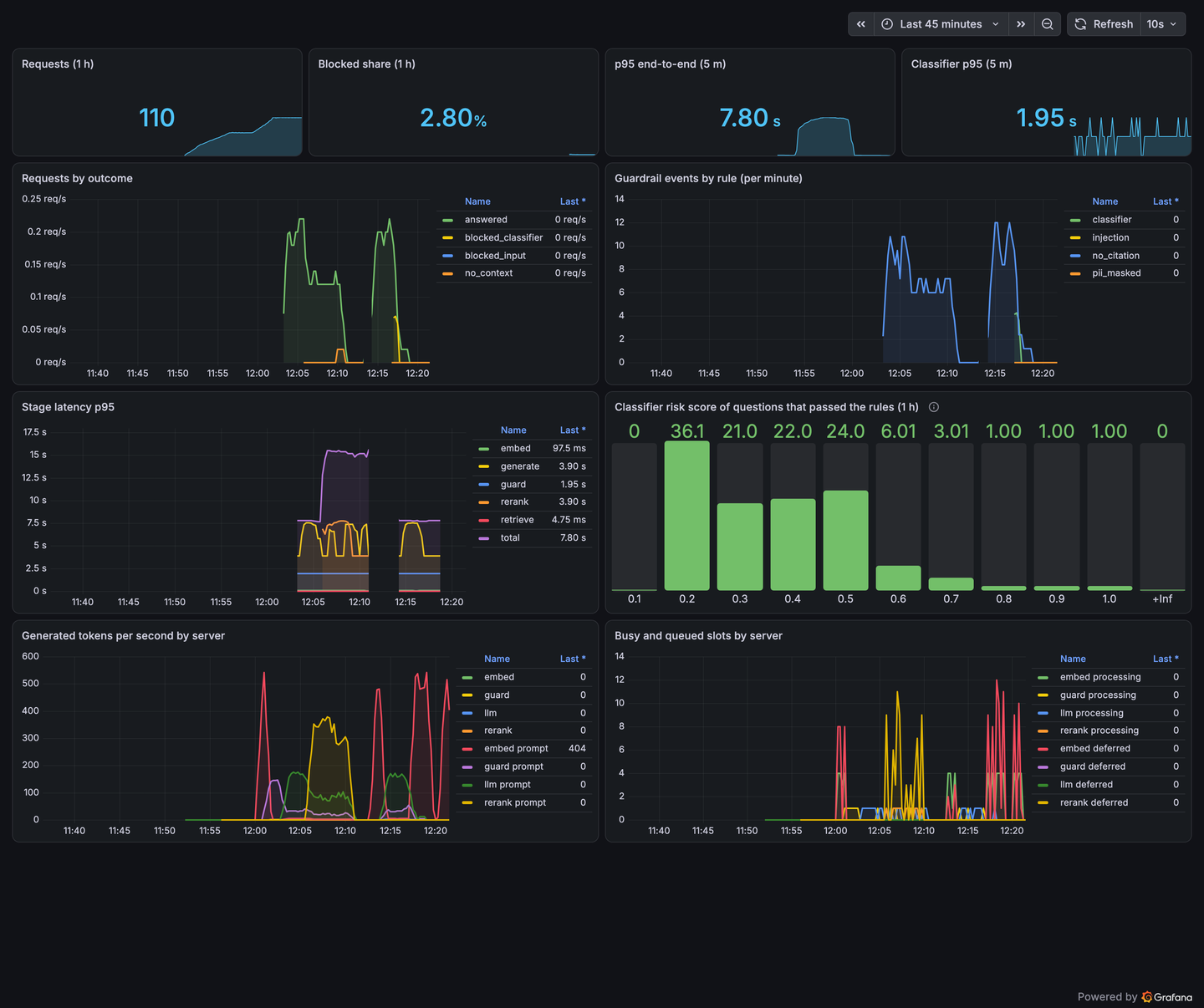
Grafana dashboard: requests by outcome, guardrail events, stage latency, classifier score histogram, tokens per second and slots per model server
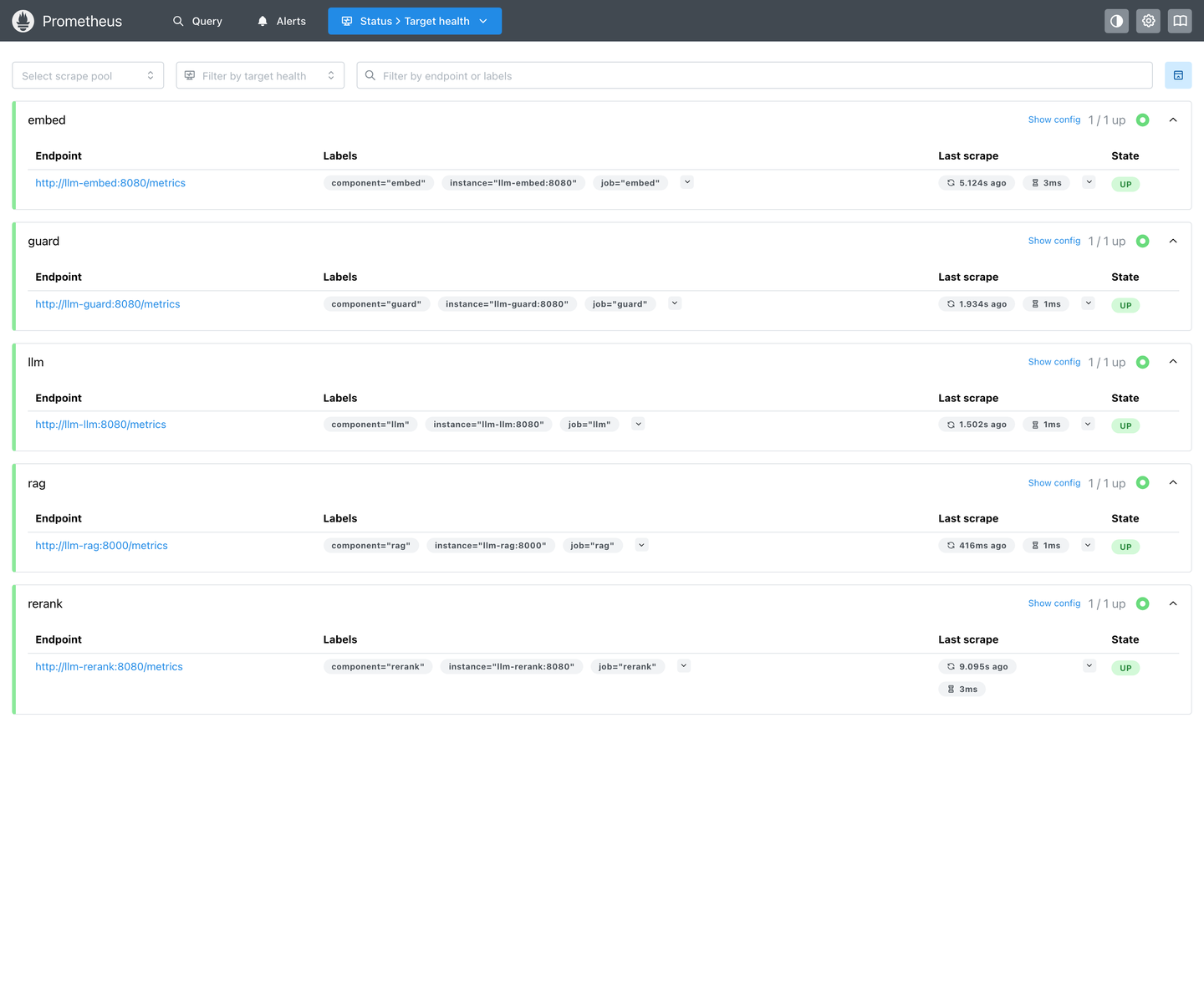
Prometheus target health: rag, llm, embed, guard and rerank all up
Latency and throughput versus concurrency for the LLM and the RAG API
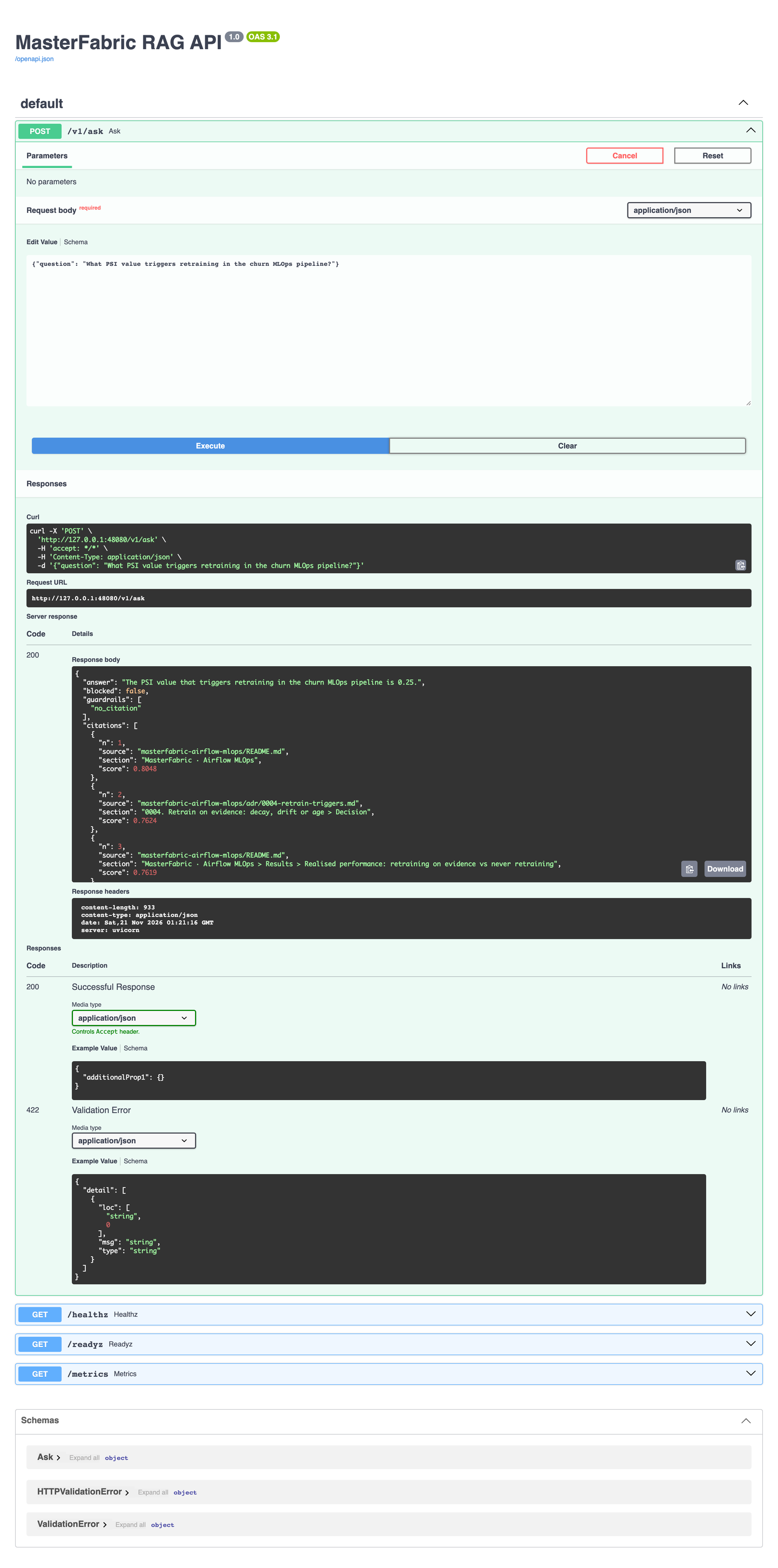
Swagger UI of the RAG API with a live answer and citations